Quick answer: The 2026 Formula 1 Mexico City Grand Prix runs from Friday 30 October to Sunday 1 November 2026 at the Autódromo Hermanos Rodríguez, as Round 20 of the World Championship. It collides head-on with Día de Muertos — the city’s official Day of the Dead parade is scheduled for Saturday 31 October — which makes this the single busiest and most expensive weekend on Mexico City’s calendar. Book accommodation and race tickets months ahead, and stay somewhere with a direct Metro line to the circuit: Line 9 runs from Roma Norte to Ciudad Deportiva without a single transfer.
What’s on this page
- The official 2026 dates and race weekend format
- Why 2026 is different: F1 and Day of the Dead in the same 72 hours
- The Autódromo Hermanos Rodríguez, explained
- Getting to the circuit from Roma Norte
- Tickets: categories, when they sell out, how not to get scammed
- Where to stay for the Grand Prix
- Altitude, weather and what to bring
- What to do between sessions
- A four-day Grand Prix itinerary
- Frequently asked questions
The official 2026 dates
The Formula 1 Mexico City Grand Prix returns to the Autódromo Hermanos Rodríguez from 30 October to 1 November 2026, as Round 20 of the 2026 FIA Formula One World Championship. Race day is Sunday 1 November.
The weekend follows the standard three-day Grand Prix format:
| Day | Date | Sessions | Typical crowd |
| Friday | 30 October 2026 | Free Practice 1 and Free Practice 2 | Lightest of the three days |
| Saturday | 31 October 2026 | Free Practice 3 and Qualifying | Heavy — qualifying is the crowd favourite |
| Sunday | 1 November 2026 | Support races and the Grand Prix | Peak |
Exact session start times are published by the promoter in the weeks before the event and can shift; treat the table above as the shape of the weekend, not as a timetable to plan a flight around.
How big this actually is
Mexico’s Grand Prix is one of the best-attended races on the calendar. The 2025 edition drew 401,326 spectators across the three days — 101,327 on Friday, 146,132 on Saturday and 153,867 on race day. That was slightly below the all-time record of 404,958 set in 2024, and it still made 2025 the second-highest attendance since Formula 1 returned to Mexico in 2015.
Put differently: on race Sunday, a crowd larger than the entire population of many capital cities converges on one corner of Iztacalco. Every assumption you have about “getting a taxi afterwards” needs to be revised downward.
Why 2026 is different: F1 and Day of the Dead in the same 72 hours
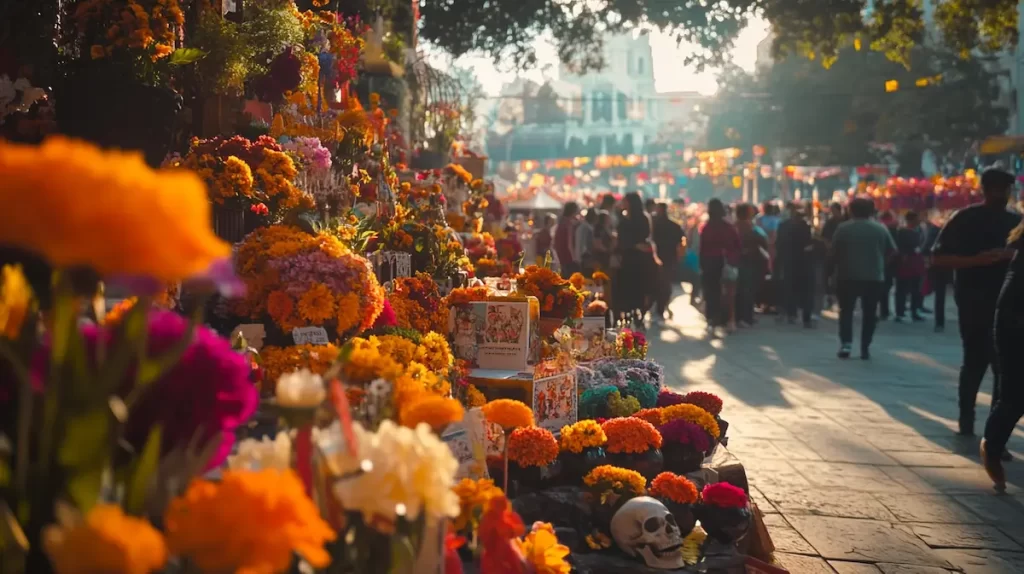
In most years the Mexican Grand Prix lands in late October, a week or so clear of Día de Muertos. Not in 2026. The race weekend runs 30 October to 1 November. Día de Muertos is observed on 1 and 2 November, and Mexico City’s official parade — the tenth edition, organised by the city government through its Ministry of Culture — is scheduled for Saturday 31 October, the same day as Formula 1 qualifying.
This has four practical consequences.
1. Hotel rates peak, and inventory disappears early
Two of the highest-demand events in the city’s year are stacked on the same nights. Rooms that are available in mid-year are frequently gone by September, and rates for the last week of October behave nothing like the rest of autumn. If your dates are fixed, treat accommodation as the first booking you make, not the last.
2. You cannot do both the parade and qualifying properly
The parade traditionally moves through the city’s central axis and ends around the Zócalo; qualifying happens 10 km east at the circuit. Both are afternoon events. Pick one for Saturday. Most visitors we host choose qualifying on Saturday and give Sunday evening — after the race — to the ofrendas, altars and street life, which run for days rather than hours. Our complete Day of the Dead 2026 guide lays out what happens on each date, and the parade guide covers the route and best viewing spots specifically.
3. Traffic patterns are unlike any other weekend
Central road closures for the parade and eastbound congestion for the circuit happen simultaneously. Ride-hailing surge pricing on the Saturday afternoon of a Grand Prix weekend is legendary. The Metro is not merely the cheap option that weekend — it is the reliable one.
4. The city is at its most spectacular
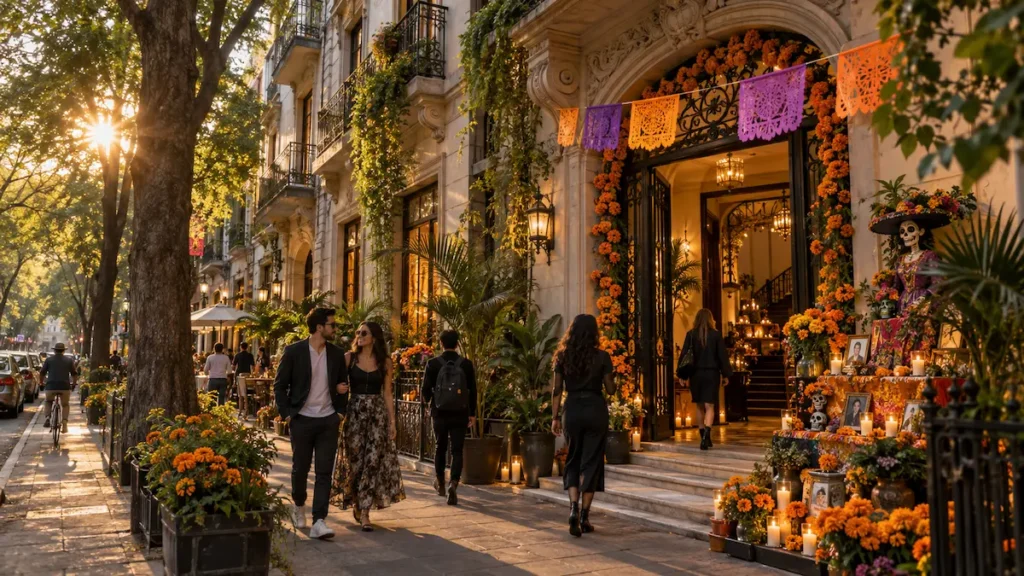
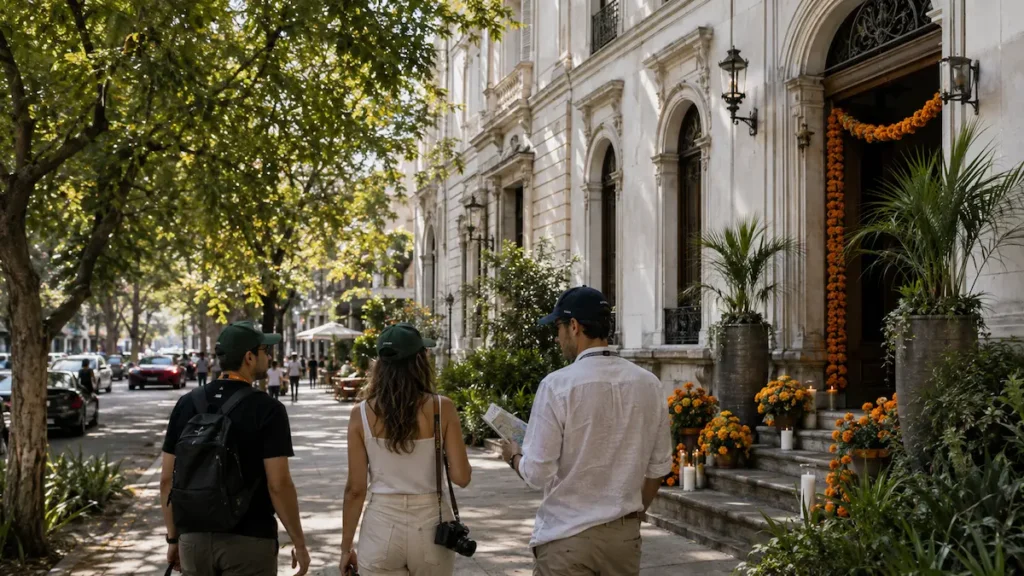
Marigold arches, altars in every lobby, catrinas on Avenida Álvaro Obregón, and 400,000 people in team colours. If you have ever wanted to see Mexico City at maximum intensity, this is the weekend. Just arrive with a plan.
The Autódromo Hermanos Rodríguez, explained
The circuit sits inside the Ciudad Deportiva Magdalena Mixhuca sports complex in the Iztacalco borough, roughly 10 km east of Roma Norte. It is named after brothers Ricardo and Pedro Rodríguez, Mexico ‘s pioneering Formula 1 drivers.
Three things make it unlike any other track on the calendar:
- Altitude. At roughly 2,240 metres above sea level, it is by far the highest-altitude race of the season. Thin air means less aerodynamic downforce and less drag — cars reach some of the highest top speeds of the year down the main straight while cornering with far less grip than the same wing setup would give at sea level.
- The stadium section. The lap threads through the Foro Sol baseball stadium, where grandstands surround the cars on both sides. It is the most famous piece of theatre in modern Formula 1 and the reason the Mexican Grand Prix has repeatedly been voted the sport’s best event.
- Turn 1. A long run to a heavy braking zone into a tight right-hander, which produces first-lap chaos with reliable frequency.
Getting to the circuit from Roma Norte
This is where where-you-sleep turns into how-much-of-your-weekend-you-keep.
Metro — the option that actually works
Line 9 (dark brown) connects Roma Norte directly to the circuit with no transfers. Board at Chilpancingo and ride east to Ciudad Deportiva or Velódromo; both stations put you within walking distance of the Autódromo gates, and both are heavily staffed with crowd-control marshals on Grand Prix days.
A single Metro journey costs 5 pesos, a fare unchanged since December 2013 and confirmed to hold for 2026. You will need a rechargeable Movilidad Integrada card, sold and topped up at station machines. Buy and load it on a quiet day earlier in your trip — the queues on race Sunday are not where you want to learn how the machine works.
By car or ride-hail
Roughly 10 km, which is 25 minutes on an empty Tuesday and considerably more on race day. Ride-hailing apps apply heavy surge pricing in both directions and drop-off points are pushed progressively further from the gates as the crowd builds. If you do ride, go early and walk the last stretch.
On foot from the Metro
Wear real shoes. Between the station, the gates, the walk to your grandstand and the return, a race day comfortably clears 12,000 steps.
If you want the full picture of how the city’s transport network fits together — including the airport run — our airport to Roma Norte transport guide covers the routes, costs and the traps. For general ground rules on getting around, see our practical travel tips for first-time visitors.
Tickets: categories, timing and how not to get scammed
Tickets are sold by the official promoter and its authorised ticketing partners. The broad structure:
| Type | What you get | Best for |
| General admission | Standing/unreserved viewing in designated zones | Cheapest entry; arrive very early for a good spot |
| Grandstands (numbered) | A reserved seat in a specific stand — Main, and stands 2A through 6B along the lap | Most visitors; guaranteed seat and a fixed view |
| Foro Sol / stadium section | Seats inside the baseball stadium the track runs through | Atmosphere above all else; cars pass three times per lap |
| Hospitality | Premium seating with food, beverage and often paddock access | Corporate guests and anyone prioritising comfort |
Three rules that save people money and grief:
- Buy from official channels only. The Mexican Grand Prix attracts a heavy secondary market and counterfeit tickets are a genuine problem. Note that several well-ranked websites selling “official” Mexico Grand Prix tickets are independent resellers, not the promoter.
- Three-day passes are the norm. Most categories are sold for the full weekend rather than by the day, so factor that into the budget.
- Book early — for 2026, unusually early. The Day of the Dead overlap means both demand curves peak together.
Where to stay for the Mexico City Grand Prix
There is a temptation to book as close to Iztacalco as possible. It is a mistake. The area immediately around the Autódromo is an industrial and sports district with very little to do once the engines stop, and you are one Metro line from far better neighbourhoods.
What actually matters for a Grand Prix weekend:
- A direct transport line to the circuit — so the commute is 25 minutes, not an hour of transfers.
- Somewhere worth returning to at 8pm — restaurants, bars and walkable streets, because the evenings are half the trip.
- Quiet rooms — you will be up early three days running.
Roma Norte satisfies all three. It sits on Metro Line 9, it has the densest concentration of good restaurants and bars in the city, and it is residential enough to sleep in. Our Roma Norte neighbourhood guide explains the area in full, and Roma Norte vs Condesa vs Polanco compares it against the alternatives.
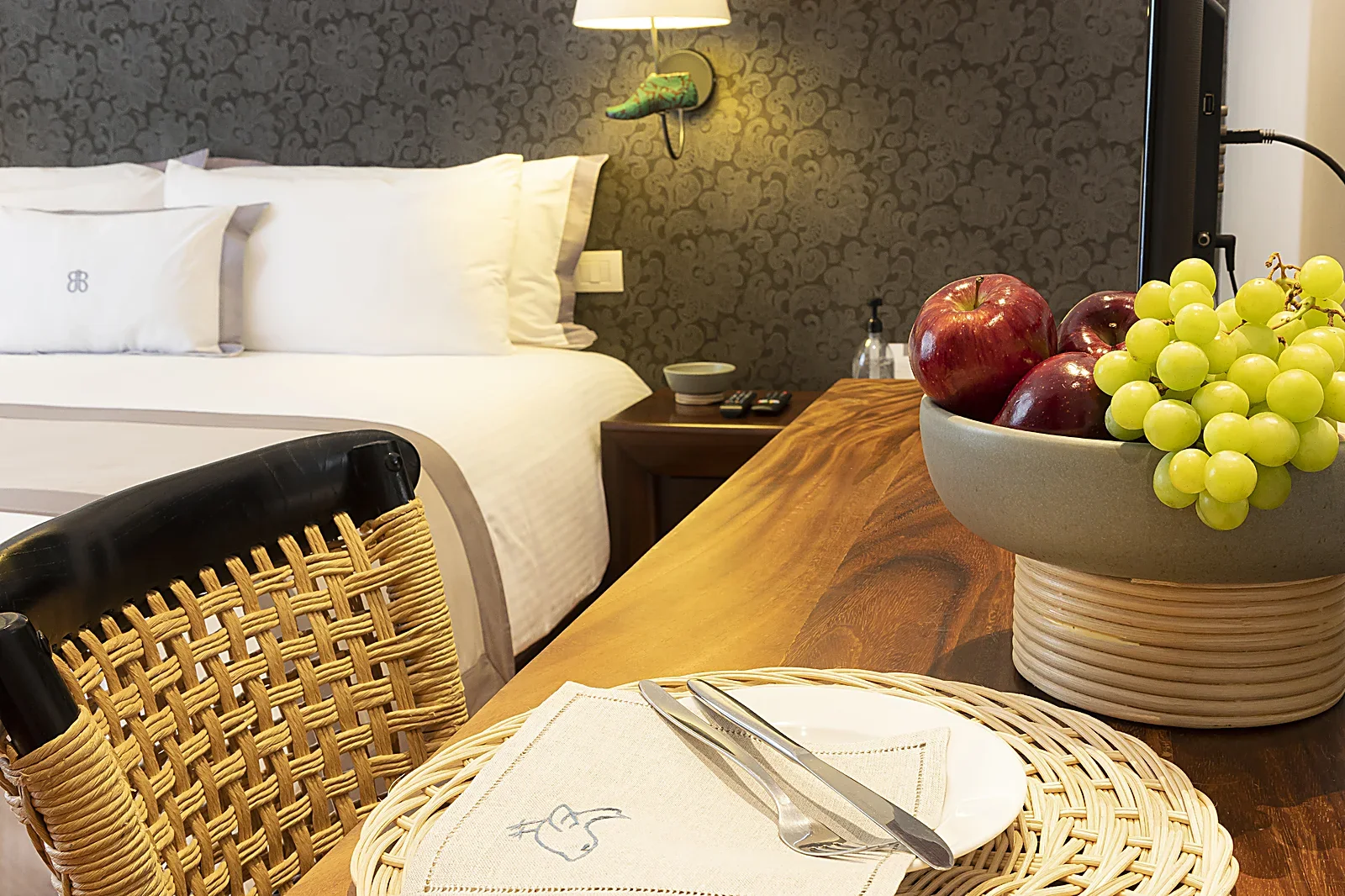
Casa Goliana is an eight-room boutique hotel in a restored early-twentieth-century mansion at Guanajuato 199, in the heart of Roma Norte. Breakfast is included — useful when you are leaving before the crowds — and the house is quiet enough to recover in after a day of 400,000 people. You can see the rooms on our rooms page or check dates directly on our booking page. For the last week of October 2026, we would not wait.
Altitude, weather and what to bring
Mexico City sits at approximately 2,240 metres (about 7,350 feet) above sea level. Most visitors feel it as mild breathlessness on stairs for the first day or two, plus faster dehydration. Drink more water than feels necessary, go easy on alcohol the first night, and do not schedule anything strenuous for your arrival day.
Late October and early November fall at the end of the rainy season and the start of the dry season, which in central Mexico runs roughly November to May. Expect daytime highs around 22°C and overnight lows around 9°C in November, with rain becoming rare — November averages very few wet days. The practical consequence is a wide daily swing: it is genuinely warm in the grandstand at 2pm and genuinely cold walking to the Metro at 8pm.
Bring: layers you can carry, a hat and high-SPF sunscreen (thin air means strong UV), refillable water, ear protection if you are noise-sensitive, a portable battery, and cash in small notes for food stalls. Check the venue’s published policy before you pack a bag — bag size limits and prohibited items are enforced at the gates.
What to do between sessions
Friday practice ends in the early evening and Saturday qualifying wraps by late afternoon. That leaves real time, and Roma Norte is a five-minute walk from most of it.
- Eat properly. Roma Norte’s dining is the reason many people move here. Start with our guides to the best restaurants in Roma and the best tacos and street food in the neighbourhood.
- Drink somewhere good. The Roma Norte bars and nightlife guide is built for exactly this window.
- See the art. The self-guided gallery tour and the architectural walking tour both fit in an afternoon.
- Go to a museum. If you have a spare morning, our guide to the best museums in Mexico City covers what is genuinely worth the queue. Note that almost everything closes on Mondays.
- Take the classic excursions. If you are extending the trip either side of the race, Teotihuacán and Xochimilco are the two canonical day trips — in opposite directions, so one per day.
- See lucha libre. Arena México is 2.5 km from Roma Norte and runs Friday night shows. It is the closest thing the city has to a second sporting spectacle — see our lucha libre guide.
A four-day Grand Prix itinerary
Thursday 29 October — arrive and acclimatise
Land, check in, do nothing strenuous. Walk Álvaro Obregón, eat early, sleep. Buy and load your Metro card tonight.
Friday 30 October — practice
Metro Line 9 to Ciudad Deportiva mid-morning. Both practice sessions, back by early evening. Dinner in Roma Norte. If you still have energy, a Friday-night lucha libre card starts at 8:30pm.
Saturday 31 October — qualifying, then Day of the Dead
The big decision day. Qualifying at the circuit in the afternoon; the city’s Day of the Dead parade runs the same afternoon downtown. Do one. If you choose the circuit, come back and give the evening to the altars and the street atmosphere in Roma and Condesa, which run late.
Sunday 1 November — race day
Leave earlier than you think you need to. Support races fill the morning. After the race, do not fight for a taxi — walk to the Metro with the crowd. Sunday night is also Día de Muertos proper, so the city will still be going when you get back.
Monday 2 November — the quiet day
The second day of Día de Muertos and, mercifully, a slow one. Cemeteries and neighbourhood ofrendas, a long breakfast, a museum. Fly out in the evening if you must.
For a broader version of the same city in the same period, see our guide to Mexico City in November, which covers the whole month’s events including Corona Capital and El Buen Fin.
Frequently asked questions
When is the 2026 Formula 1 Mexico City Grand Prix?
From Friday 30 October to Sunday 1 November 2026, at the Autódromo Hermanos Rodríguez in Mexico City. It is Round 20 of the 2026 World Championship, with the race itself on Sunday 1 November.
Does the 2026 Grand Prix overlap with Day of the Dead?
Yes, directly. Mexico City’s official Day of the Dead parade is scheduled for Saturday 31 October 2026 — the same day as Formula 1 qualifying — and Día de Muertos itself falls on 1 and 2 November. This is the busiest weekend on the city’s calendar in 2026.
How do I get to the Autódromo Hermanos Rodríguez by public transport?
Metro Line 9 to Ciudad Deportiva or Velódromo. From Roma Norte you can board at Chilpancingo and ride east with no transfers. A single journey costs 5 pesos with a Movilidad Integrada card.
How many people attend the Mexican Grand Prix?
The 2025 edition drew 401,326 spectators across three days: 101,327 on Friday, 146,132 on Saturday and 153,867 on race day. The record is 404,958, set in 2024.
Does the altitude affect the race?
Significantly. At roughly 2,240 metres, the Autódromo Hermanos Rodríguez is the highest-altitude circuit on the Formula 1 calendar. Thinner air reduces both aerodynamic downforce and drag, producing very high top speeds on the main straight alongside unusually low cornering grip. Spectators feel the altitude too — expect mild breathlessness and faster dehydration for the first day or two.
Which neighbourhood should I stay in for the Grand Prix?
Roma Norte is the strongest all-round choice: it sits on Metro Line 9, which runs directly to the circuit with no transfers, and it has the city’s densest concentration of restaurants and bars for the evenings. Staying next to the Autódromo itself puts you in an industrial sports district with little to do once sessions end.