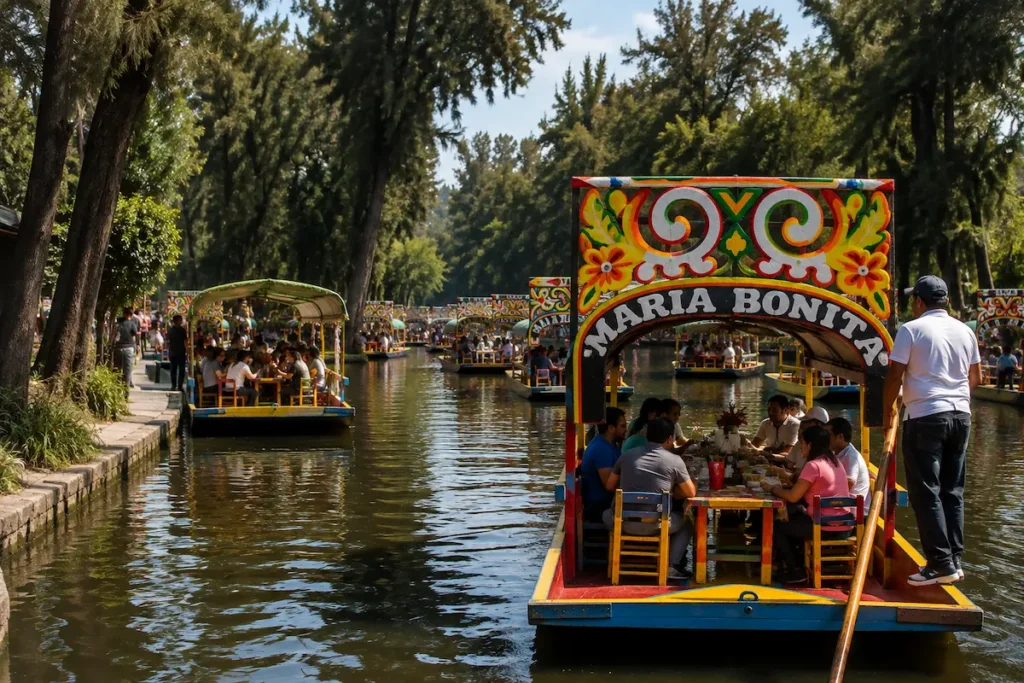
Quick answer: Xochimilco is a UNESCO World Heritage Site — inscribed in 1987 alongside Mexico City’s historic centre — built on roughly 184 kilometres of pre-Hispanic canals. You explore it on a trajinera, a flat-bottomed painted boat poled by a remero. The official 2026 rate is 750 pesos per hour, per boat, not per person, and the same price applies whether one person boards or eighteen. Boats depart from eleven official piers between roughly 8:00am and 5:00pm. Go on a weekday morning if you want the canals; go on a Saturday afternoon if you want the party.
What’s on this page
- What Xochimilco actually is
- The official price, and the scam it prevents
- Which pier to choose
- Getting there from Roma Norte
- When to go: weekday calm versus weekend party
- What happens on the water
- The chinampas, the axolotl and the serious side
- The Island of the Dolls
- Practical checklist
- Frequently asked questions
What Xochimilco actually is
Before the Spanish drained the valley, Mexico City was a city on a lake. Xochimilco is what survives of it: a working network of canals and artificial agricultural islands in the south of the city, farmed continuously since before the Mexica empire.
UNESCO inscribed it as a World Heritage Site in 1987, together with the historic centre, and it remains the only place where you can see the lacustrine landscape that the rest of Mexico City was built on top of. Around 184 kilometres of waterways remain navigable.
Two things visitors consistently get wrong about it:
- It is not a theme park. The chinampas are still farmed, families still live along the canals, and the flower nurseries that give the district its name — Xochimilco, “the place of the flower fields” in Nahuatl — are commercial operations.
- It is not quiet. On a weekend it is one of the loudest, most joyful places in Mexico: mariachi boats pulling alongside, food boats, families, portable speakers, entire birthday parties afloat. Whether that is the experience you want determines when you should go.
The official price, and the scam it prevents
The regulated rate for 2026 is 750 pesos per hour, per trajinera. This is the single most useful fact on this page, because the most common problem visitors have at Xochimilco is being quoted a price per person.
| What is true | What you may be told |
| 750 pesos per hour, for the whole boat | “750 pesos each” |
| Between 1 and 18 people, same price | “There’s a surcharge for a large group” |
| The rate is published on official signage at each pier | “That’s the old price” |
| The clock starts when the boat departs | The clock quietly started when you arrived at the pier |
How to handle it, calmly:
- Find the official rate board at the pier before you speak to anyone. Every authorised embarcadero displays one.
- Agree the total out loud before boarding: number of hours × 750 pesos. Say the total figure back to the remero.
- Confirm when the hour starts — at departure, not at arrival.
- Understand that mariachi and food boats are extra, negotiated separately, per song or per plate. That is normal and legitimate; it is simply not included.
- Bring cash in small notes. Change for a 500-peso note is not guaranteed on the water.
- Tipping the remero is customary and deserved — he poles the boat for the entire trip.
Two hours is the standard trip and the right length for a first visit. One hour feels rushed; three is a commitment unless you are there to party.
Which pier to choose
There are eleven official embarcaderos, and which one you pick shapes the day more than anything else.
| Pier | Character | Best for |
| Nativitas | The largest and most traditional. Busiest, most food and mariachi boats, most atmosphere | The classic full-volume experience |
| Zacapa | Traditional, near the Bosque de Nativitas, slightly calmer than Nativitas itself | A good middle ground |
| Las Flores | Also in the Nativitas cluster; convenient and well organised | Families |
| Cuemanco | Northern pier, closer to the ecological zone and the wilder canals | Chinampas, birdlife, the Island of the Dolls |
| Fernando Celada | Central, close to Xochimilco’s own town centre and market | Combining the canals with the town |
Short version: want the party, go to Nativitas. Want the landscape, the farms and the wildlife, go to Cuemanco.
Getting there from Roma Norte
Xochimilco is around 25 km south of Roma Norte, in the far south of the city. Budget an hour each way and treat it as a half-day at minimum.
By public transport
Metro Line 1 east from Insurgentes to Pino Suárez, change to Line 2 south to Tasqueña (the southern terminus), then the Tren Ligero light rail all the way to Xochimilco, its final stop. From the station it is a short walk or a brief taxi ride to the nearest piers. Total cost is a handful of pesos; total time is around 75–90 minutes.
By car or ride-hail
45 to 70 minutes depending on traffic, and considerably more on a Sunday afternoon. Ride-hailing is straightforward in both directions, and coverage at the main piers is reliable.
Combining it with Coyoacán
Both are in the south, and the Tren Ligero passes close to Coyoacán on the way. A common and sensible plan is Xochimilco in the morning and Coyoacán — the Casa Azul, the plaza, the market — in the afternoon. If you want to do that, book your Frida Kahlo Museum slot for mid-afternoon and go to the canals at opening.
When to go: weekday calm versus weekend party
| When | What it’s like |
| Weekday morning (Tue–Thu, 9–11am) | Quiet water, working chinampas, birds, good light, few other boats. The version that looks like the photographs |
| Weekday afternoon | Moderate. A reasonable compromise |
| Saturday | Busy and festive from midday. Mariachis, food boats, families, music |
| Sunday | Peak. Genuinely crowded, genuinely fun, and the canals can back up in the narrow sections |
One useful exception: during the Formula 1 Grand Prix weekend, 30 October to 1 November 2026, the city’s crowd is concentrated at the Autódromo and in the centre for the Day of the Dead parade. The south of the city is comparatively quiet that Friday morning.
Opening hours run roughly 8:00am to 5:00pm. There is no lighting on the canals, so late-afternoon departures are cut short — start before 3:00pm.
Around Día de Muertos, Xochimilco runs special evening programming and the canals take on an entirely different character — candlelit, quiet and genuinely moving. Those trips have their own schedules and sell out; see our Day of the Dead 2026 guide and our month-by-month guide to Mexico City in November.
What happens on the water
You board a wooden, flat-bottomed boat with a painted arch over the bow, usually bearing a woman’s name, with a long table and chairs down the middle. The remero stands at the stern and poles you along. Then the canal comes to you:
- Mariachi boats pull alongside and play per song, negotiated on the spot.
- Marimba trios do the same, more cheaply.
- Food boats cook quesadillas, elotes and esquites over charcoal, alongside your moving boat.
- Drink boats sell beer, micheladas and pulque.
- Flower and craft sellers work the same route.
You are permitted to bring your own food and drink, and most Mexican families do — this is a picnic tradition as much as a boat trip. Buying supplies at the market by the pier before you board is both cheaper and more fun than buying afloat.
The chinampas, the axolotl and the serious side
The rectangular islands between the canals are chinampas: artificial agricultural plots built up from lake mud and vegetation, anchored by willow trees, and farmed with a productivity that still impresses agronomists. They are a pre-Hispanic agricultural system in continuous use, and the reason the site carries its heritage status.
The canals are also the last wild habitat of the axolotl (Ambystoma mexicanum) — the neotenic salamander that never metamorphoses, regenerates limbs, and has become a national emblem. It is critically endangered in the wild, threatened by water quality, urban expansion and introduced fish. You will almost certainly not see one from a trajinera; you can see them at the axolotl conservation projects and ecological centres near the Cuemanco end.
If the ecology is what interests you, choose Cuemanco, ask for the zona chinampera or an ecological route rather than the party circuit, and go on a weekday. Several chinampa farms in the area run visits and lunches; they are a completely different day out from the mariachi route, and for many visitors a better one.
Other ways to experience Xochimilco
The trajinera is the classic way to see Xochimilco, but it isn’t the only one. A growing number of operators run gastronomic experiences that start at dawn, ending in breakfast served on one of the working chinampas — a quieter, slower version of the same landscape. Others run ecotourism trips by kayak, timed to catch sunrise on the canals before the trajineras and the crowds arrive.
These are worth considering if you want the chinampas and the water without the mariachi-boat atmosphere, or if you are visiting on a weekend and would rather have the calm version of the day. They typically need to be booked in advance and run on a fixed schedule, unlike the trajineras.
The Island of the Dolls
La Isla de las Muñecas is a chinampa hung with hundreds of weathered dolls, assembled over decades by a caretaker who said he was honouring a girl who drowned nearby. It has become one of the most photographed oddities in Mexico.
The practical reality: it is far — typically a two-to-four-hour round trip by boat from Cuemanco, on top of the standard rate, and it must be agreed in advance. Several nearer “islands of the dolls” have been assembled to catch visitors who do not know the difference. If you want the real one, go from Cuemanco, agree the destination and the total price before departing, and set aside the best part of a day.
Practical checklist
- Cash, in small notes. Card payment on the water is not a thing.
- Sunscreen and a hat. There is minimal shade on a trajinera and the UV at 2,240 metres is strong.
- A layer. The water is cooler than the street, and it drops fast late in the day.
- Toilets before you board. There are none on the boat.
- Two hours is the right first trip.
- Agree the total price out loud before you step on.
- Do not swim. The water is not clean, whatever anyone tells you.
One broader point that applies to the whole day: Xochimilco is a cash economy operating at 2,240 metres in strong sun, and both of those catch visitors out. Our practical travel tips for first-time visitors cover altitude, cash, tipping and the rest of the groundwork.
What Xochimilco is not
Three expectations worth adjusting before you go, because managing them is the difference between a memorable morning and a disappointed one.
- It is not Venice. The canals are agricultural infrastructure, not a monumental cityscape. The beauty here is in the willows, the flower nurseries, the working chinampas and the quality of the light on the water — not in the architecture.
- It is not a guided experience. Your remero poles the boat; he is not a guide, and most speak limited English. If you want the history and ecology explained, either book a chinampa tour from Cuemanco or read up before you board.
- It is not a short stop. Between the journey each way and two hours on the water, this is five hours of your day minimum. Treat it as the day’s main event, not as something you slot in between two others.
What it is: the last visible fragment of the lake city that Tenochtitlan was built in, still being farmed by the descendants of the people who built it. Very few places on earth offer that, and none of the others give you mariachi.
Making an evening of it
You will get back to central Mexico City in the late afternoon, sunburnt and pleasantly tired. Two good ways to finish:
- Dinner in Roma Norte. The neighbourhood is at its best in the evening — see our Roma restaurants guide and the bars and nightlife guide.
- Lucha libre. If your Xochimilco day falls on a Tuesday, Friday or Sunday, Arena México has a card that evening — indoors, seated and no further walking required. See our Arena México guide.
Fitting it into a trip
Xochimilco is a half-day, and it pairs naturally with the southern half of the city. Our best day trips from Mexico City guide places it against the alternatives, and our Teotihuacán guide covers the other canonical excursion — the two are the classic pair, and they are in opposite directions, so do not attempt both in one day.
For a full three-day plan that fits Xochimilco alongside the museums and the neighbourhoods, see our three-day Mexico City itinerary. And if you are buying food for the boat, our markets guide covers where to stock up.
Where to stay
Nobody stays in Xochimilco — it is a visit, not a base. Stay central and go south for the morning. Roma Norte sits on Metro Line 1 with a clean connection to the Line 2 and Tren Ligero route, and it is where you want to be for dinner afterwards. See our Roma Norte neighbourhood guide.
Casa Goliana is an eight-room boutique hotel in a restored early-twentieth-century mansion at Guanajuato 199, Roma Norte, with breakfast included — useful on a day you want to be on the water by nine. See the rooms or check dates on the booking page.
Frequently asked questions
How much does a trajinera cost in Xochimilco in 2026?
The official regulated rate is 750 pesos per hour, per boat — not per person. Between one and eighteen people can board for the same price. Every authorised pier displays the official rate on signage. Mariachi, food and drink from passing boats are extra and negotiated separately.
How do I get to Xochimilco from central Mexico City?
Metro Line 1 to Pino Suárez, Line 2 south to Tasqueña, then the Tren Ligero light rail to its final stop, Xochimilco. Around 75 to 90 minutes for a few pesos. By car or ride-hail it is 45 to 70 minutes from the central neighbourhoods, more on Sunday afternoons.
What are the opening hours at Xochimilco?
Boats run roughly 8:00am to 5:00pm. There is no lighting on the canals, so departures after about 3:00pm get cut short. Special evening programming runs around Día de Muertos with its own schedules.
Which Xochimilco pier is best?
Nativitas for the classic, busy, mariachi-and-food-boat experience. Cuemanco for the chinampa farmland, the ecological zone, birdlife and the genuine Island of the Dolls. Zacapa and Las Flores sit between the two in atmosphere.
Is Xochimilco worth visiting on a weekday?
Yes, and for many visitors it is better. A weekday morning gives you quiet water, working chinampas, birds and good light. Weekends — particularly Sunday — are crowded and festive, which is wonderful if the party is what you came for and frustrating if it is not.
Can you see axolotls at Xochimilco?
Not from a standard trajinera trip. The axolotl is critically endangered in the wild and rarely visible in open canals. Conservation projects and ecological centres near the Cuemanco pier keep them and are the reliable way to see one.