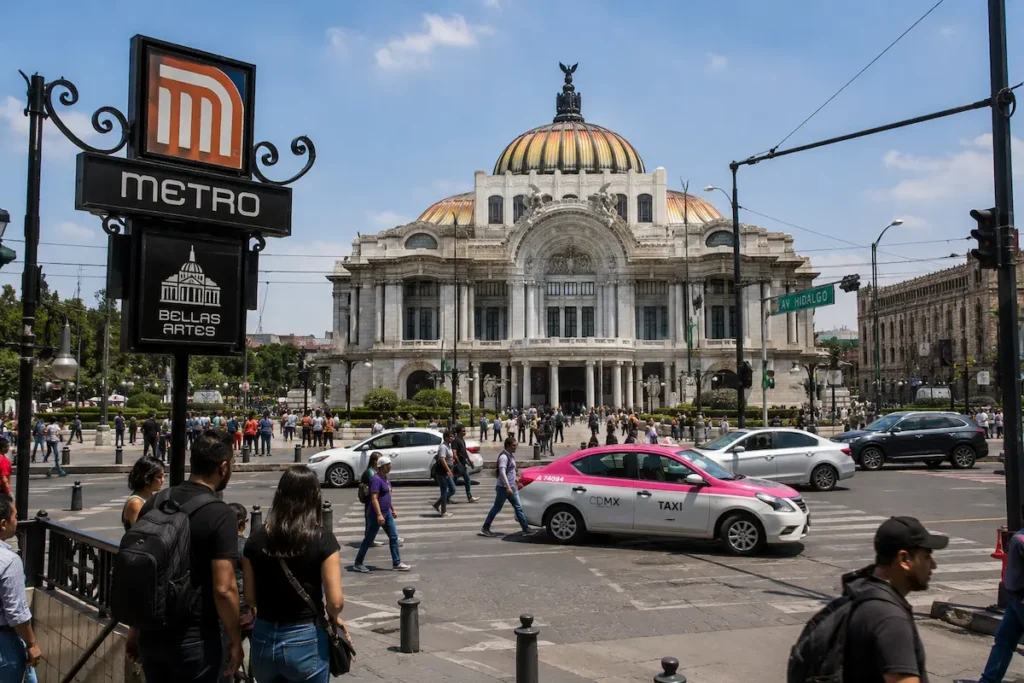
Quick answer: Mexico City sits at roughly 2,240 metres (7,350 ft), so take your first day slowly and drink more water than usual. Do not drink the tap water — purified water is universal and free at most hotels. Tip 10–15% in restaurants. The Metro costs 5 pesos a ride, a fare unchanged since 2013. Mexico abolished daylight saving in 2022, so the time difference with the United States changes twice a year even though Mexico City’s clocks never move. And if a loudspeaker alarm goes off across the whole city on 19 September, it is the national earthquake drill, not an emergency.
What’s on this page
- Altitude: the thing nobody warns you about
- Water, food and the stomach question
- Money, cards, ATMs and tipping
- Getting around
- Time zones, and why the difference keeps changing
- Earthquakes and the 19 September drill
- Phones, plugs, emergencies, language
- Etiquette and small courtesies
- Nine mistakes first-timers make
- Frequently asked questions
Altitude: the thing nobody warns you about
Mexico City is one of the highest large cities in the world, at approximately 2,240 metres — around 7,350 feet. That is higher than Denver. Most visitors arrive with no expectation of feeling it, and then feel it.
The symptoms are mild but real for the first 24–48 hours: breathlessness on stairs and gentle slopes, a duller-than-usual headache, disrupted sleep on the first night, and faster dehydration. Alcohol also hits noticeably harder.
What actually helps:
- Do nothing strenuous on arrival day. Walk your neighbourhood, eat somewhere close, go to bed early. Do not schedule the pyramids for day one.
- Drink more water than feels necessary, starting on the plane.
- Go easy on alcohol the first night. One drink at 2,240 metres does not behave like one drink at sea level.
- Eat normally. Skipping meals makes it worse.
- Sunscreen, always. Thinner air means significantly stronger ultraviolet radiation, and it is easy to burn on a 20°C day that does not feel hot at all.
By day three you will not think about it. It is day one that catches people, which is why every itinerary in our guides — including the three-day Mexico City itinerary — keeps the first afternoon deliberately light.
Water, food and the stomach question
Tap water
Do not drink it. This is not paranoia and it is not about the water leaving the treatment plant — it is about the age and condition of the distribution network and the rooftop storage tanks that most buildings use.
In practice this is a non-issue, because purified water is everywhere: hotels provide it, restaurants serve it by default, and shops sell it for very little. Use bottled or purified water for drinking. Showering and washing are fine. Brushing your teeth with tap water is a personal risk assessment; most residents do it, most short-stay visitors do not.
Ice in restaurants, bars and cafés is made with purified water and is safe. The paranoid rule about avoiding all ice is decades out of date in the city.
Street food
Street food in Mexico City is one of the great food cultures on earth and avoiding it out of caution would be a genuine loss. The sensible heuristics:
- Go where the queue is. High turnover means fresh ingredients. An empty stall at 2pm is telling you something.
- Cooked hot, in front of you, is the safest food there is.
- Be more cautious with raw salsas and uncooked garnishes in the first day or two while your system adjusts.
- Carry hand sanitiser. Stalls rarely have sinks.
Our guide to the best tacos and street food in Roma Norte covers where to start, and the markets guide covers the sit-down version.
Money, cards, ATMs and tipping
Currency
The Mexican peso (MXN). Prices are written with a dollar sign, which confuses visitors constantly: $200 on a menu means 200 pesos, not 200 US dollars.
Cards versus cash
| Where | Cards | Cash |
| Hotels, restaurants, bars, shops | Universally accepted | Fine |
| Markets and street food | Rarely | Essential |
| Taxis | Sometimes | Essential |
| Ride-hailing apps | Card in-app | Optional |
| Museums | Usually | Useful backup |
| Xochimilco, tips, small vendors | No | Essential |
Carry cash in small notes. Breaking a 500-peso note at a taco stand is a problem you create for someone else.
ATMs
- Use ATMs inside bank branches or inside shopping centres, during the day, rather than standalone machines on the street.
- When the machine offers to charge you in your home currency, always decline and choose pesos. Dynamic currency conversion is a consistently bad exchange rate.
- Airport exchange desks give poor rates. Withdraw from an ATM instead.
Tipping
| Situation | Customary |
| Restaurants | 10–15%. Check whether service is already included before adding |
| Bars | Round up, or roughly 10% |
| Taxis | Not expected; round up if you like |
| Hotel housekeeping | 50–100 pesos per day, depending on the length of your stay |
| Porters | 20–50 pesos on arrival and 20–50 pesos on departure |
| Supermarket baggers | Small coins — often older people or students working for tips alone |
| Petrol station attendants | Around 10 pesos for basic service. |
| Viene-vienes (informal parking attendants) | Around 10 pesos for parking assistance |
For what things actually cost across a trip or a longer stay, see our cost of living in Mexico City 2026 guide.
Getting around
Metro
5 pesos per journey, a fare that has not changed since December 2013 and holds for 2026 — one of the cheapest metro systems in the world. You need a rechargeable Movilidad Integrada card, bought and topped up at station machines, which also works on the Metrobús, Tren Ligero and other city services.
It is fast, extensive and the only reliable way to move during rush hour. Two things to know: the front carriages are reserved for women and children during busy periods, marked and enforced by staff; and rush-hour crowding is severe, so keep bags in front of you and phones away.
Metrobús
Dedicated-lane articulated buses. Line 1 runs the length of Avenida de los Insurgentes, which makes it the single most useful surface route for anyone staying in Roma Norte or Condesa. Same card.
Ride-hailing
Uber and DiDi both operate widely and are the default evening option for most visitors: in-app payment, a traceable route, and no fare negotiation. Prices surge during rain, rush hour and major events.
Taxis
Use hotel-arranged taxis or authorised sitio ranks. Avoid flagging cars on the street, particularly at night. Agree the fare or confirm the meter before setting off.
Walking
Roma Norte, Condesa, Coyoacán, San Ángel and the Centro Histórico are genuinely walkable. Pavements are uneven, tree roots lift the paving, and drivers do not always yield at crossings — but walking is how you actually see the city. Our Roma Norte neighbourhood guide is built around that.
From the airport
Mexico City has two airports — MEX (Benito Juárez, close to the centre) and NLU (Felipe Ángeles, considerably further north). Check which one your flight uses; they are not interchangeable and the transfer times are very different. Our airport to Roma Norte transport guide covers both.
Time zones, and why the difference keeps changing
Mexico City runs on Central Time, UTC−6. The subtlety that catches out travellers from the United States and Canada:
Mexico abolished daylight saving time across most of the country in 2022. Mexico City’s clocks no longer change in spring or autumn. Yours probably still do. The result is that the time difference between Mexico City and most of the US and Europe shifts twice a year even though nothing in Mexico moves.
Practical consequence: do not rely on remembered time differences when booking calls, flights or transfers. Check the actual current offset for your travel dates.
Earthquakes and the 19 September drill
Mexico City is seismically active, and it takes this seriously and competently. Two things to know:
The seismic alert
The city has a public early-warning system — loudspeakers on poles across the city, plus phone alerts — that sounds before significant shaking reaches the valley. It is a rising alarm tone with a spoken alerta sísmica. If you hear it for real, follow staff instructions, move away from windows and heavy fittings, and use marked safe zones. Do not run for a lift.
The national drill
Every year on 19 September, Mexico holds a national earthquake drill, marking the anniversary of the catastrophic 1985 earthquake and the 2017 one that struck on the same date. The full alert sounds citywide, buildings evacuate, and streets fill with people in high-visibility vests. Additional drills are held at other points in the year.
It is announced in advance and completely routine — but if you are in Mexico City on 19 September without knowing this, hearing the whole city’s alarm system go off at once is alarming. Now you know. Our Mexican Independence Day guide covers the rest of what happens in the city that month.
Phones, plugs, emergencies, language
| Item | What you need to know |
| Emergency number | 911, nationwide, the same as the US and Canada |
| Tourist assistance | Mexico City operates a tourist assistance line; your hotel can connect you |
| Plugs and voltage | Types A and B, 127V, 60Hz — identical to the US and Canada. European and UK visitors need an adapter |
| SIM cards and eSIM | Prepaid local SIMs are cheap and sold at the airport, convenience stores and phone shops. eSIM works with the major carriers. Coverage in the city is good |
| Wi-Fi | Widespread. The city also runs free public Wi-Fi in many plazas and on the Metro |
| Language | Spanish. English is common in hotels, upmarket restaurants and tourist areas, and much less so in markets, taxis and on the Metro. A little Spanish goes a very long way |
| Pharmacies | Abundant, inexpensive, and many have an attached consulting doctor for minor issues at very low cost |
| Altitude and medication | If you have a cardiac or respiratory condition, speak to your doctor about 2,240 metres before travelling |
Etiquette and small courtesies
- Greet people. Buenos días entering a shop, buenas tardes after midday, provecho to strangers as you pass their table in a restaurant. Mexico City is a formal, courteous city underneath the chaos, and skipping the greeting reads as rude.
- Say “no, gracias” and keep moving to street vendors. Engaging and then declining takes longer for both of you.
- Do not call the country “Mexico” when you mean the city. Locals say CDMX, or México for the city and la República for the country. It is a small thing that registers.
- Meal times run late. Lunch — the main meal — is from about 2pm, dinner from 9pm. Turning up for dinner at 7pm means an empty restaurant.
- Dress up a little for dinner. Mexico City is a stylish city and the better restaurants reflect it. See the Roma restaurants guide.
- Ask before photographing people, especially vendors, performers and at religious sites.
Nine mistakes first-timers make
- Scheduling something demanding on arrival day. The altitude wins. Give it an afternoon.
- Planning a museum day on a Monday. Almost everything closes. See our museums guide.
- Assuming free Sundays apply to tourists. INAH’s free Sunday entry is for Mexican nationals and residents, not visitors on a tourist permit.
- Not booking Frida Kahlo tickets in advance. Online only, no door sales, sells out days ahead.
- Underestimating distances. Mexico City is enormous. Two attractions on the same map page can be an hour apart in traffic.
- Only carrying large notes. The best food in the city is bought with coins and 20-peso notes.
- Accepting the ATM’s home-currency conversion. Always choose pesos.
- Staying somewhere with nothing around it. Neighbourhood choice matters more here than in almost any city — see the best neighbourhood to stay in Mexico City and Roma Norte vs Condesa vs Polanco.
- Trying to see everything. Two significant things per day is a good trip. Three is a forced march.
How to structure your days
Mexico City punishes over-scheduling more than most capitals, for three reasons: the distances are large, the traffic is unpredictable, and the altitude quietly taxes everything you do. The pattern that works:
| Day | Shape | Why |
| Arrival | Your neighbourhood only. Walk, eat, sleep early | Altitude adjustment |
| Day 2 | One major museum plus its surrounding area | Chapultepec or the Centro; both are full days on their own |
| Day 3 | One excursion — Teotihuacán or Xochimilco, never both | They are 75 km apart in opposite directions |
| Day 4 | A neighbourhood day: Coyoacán, San Ángel or Roma and Condesa on foot | Recovery pace, and the best way to actually see the city |
| Evenings | One fixed thing, booked | Dinner, or a card at Arena México on a Tuesday, Friday or Sunday |
Two significant things per day. That is the rule, and everyone who ignores it spends day four exhausted in a taxi.
Check the calendar before you fix your dates
Mexico City’s calendar swings harder than most. The same week can be the best or the worst of the year depending on what is on:
- Mid-September — Independence Day on 15–16 September, with the Grito on the night of the 15th and the military parade on the 16th, a statutory holiday. See our Independence Day guide.
- Late October to early November — Día de Muertos on 1–2 November, the city parade on 31 October, and in 2026 the Formula 1 Grand Prix from 30 October to 1 November. The busiest and most expensive week of the year.
- The rest of November — El Buen Fin, the Revolution Day holiday and Corona Capital, all covered in our guide to Mexico City in November.
- December — posadas, Christmas markets and the 12 December pilgrimage. See Mexico City in December.
- Rainy season, roughly May to October — it rains hard in the late afternoon and stops. Plan mornings outdoors and afternoons indoors and it barely affects you.
Safety, briefly
Mexico City is a large city and it rewards ordinary big-city judgement: keep phones out of sight on the street and the Metro, use ride-hailing at night rather than flagging cars, do not carry more cash than you need, and stay in the well-lit central neighbourhoods after dark. Millions of visitors have entirely uneventful trips every year.
Rather than compress the subject into a paragraph, we cover it properly in our guide to the safest neighbourhoods in Mexico City for tourists, which goes area by area.
Where to stay for a first trip
For a first visit, base yourself somewhere central, walkable and residential, with transport links and restaurants on the doorstep. Roma Norte is the answer most often: tree-lined streets, Art Deco and Art Nouveau architecture, the densest concentration of good food in the city, Metro Line 1 and the Insurgentes Metrobús, and a residential calm that the tourist centre does not have.
Casa Goliana is an eight-room boutique hotel in a restored early-twentieth-century mansion at Guanajuato 199, Roma Norte. Breakfast is included, purified water is provided, check-in is from 3:00pm and check-out is at midday, and our team spends a good deal of its time answering exactly the questions on this page. See the rooms, the gallery, the FAQ, or check dates on our booking page. If you would rather ask a person, our contact page is the fastest route.
Frequently asked questions
Can you drink the tap water in Mexico City?
No. Use bottled or purified water for drinking — it is inexpensive, universally available, and provided free at most hotels and restaurants. Showering and washing with tap water are fine, and ice served in restaurants, bars and cafés is made with purified water and is safe.
How high is Mexico City and will the altitude affect me?
Approximately 2,240 metres, or 7,350 feet — higher than Denver. Most visitors feel mild breathlessness, a slight headache and faster dehydration for the first day or two, and find that alcohol has a stronger effect. Keep your arrival day light, drink plenty of water and go easy on alcohol the first night.
How much should I tip in Mexico City?
10–15% in restaurants, checking first whether service has already been added. Round up in bars and taxis, leave a small daily amount for hotel housekeeping, and keep coins for supermarket baggers, petrol attendants and informal parking attendants, all of whom work partly or entirely for tips.
How much does the Mexico City Metro cost?
5 pesos per journey — a fare unchanged since December 2013 and holding for 2026. You need a rechargeable Movilidad Integrada card, bought at station machines, which also works on the Metrobús and Tren Ligero. Front carriages are reserved for women and children during busy periods.
Does Mexico observe daylight saving time?
No. Mexico abolished daylight saving across most of the country in 2022, and Mexico City’s clocks no longer change. Because clocks in the United States, Canada and Europe still do, the time difference with Mexico City shifts twice a year — so check the current offset rather than relying on memory.
What happens on 19 September in Mexico City?
A national earthquake drill. The citywide seismic alert sounds, buildings evacuate and streets fill with marshals in high-visibility vests. It marks the anniversary of the 1985 and 2017 earthquakes, is announced in advance and is entirely routine — but it is startling if you do not know it is coming.