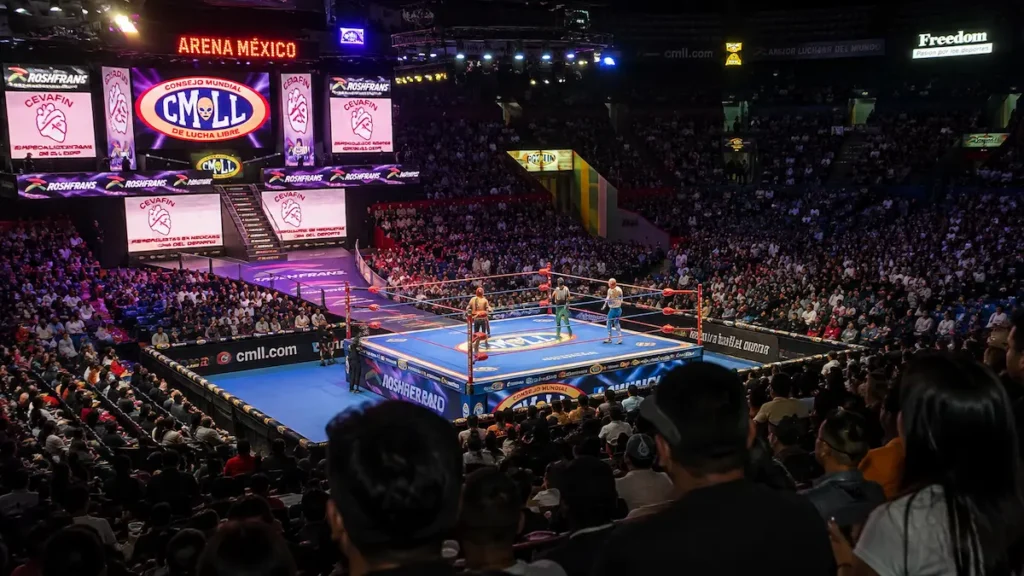
Quick answer: Arena México, at Doctor Lavista 197 in Colonia Doctores, is the home of CMLL — the oldest professional wrestling promotion in the world, founded in 1933 — and the most important lucha libre venue on earth. Regular shows run Tuesdays at 7:30pm, Fridays at 8:30pm and Sundays at 5:00pm. Friday is the flagship card, Sunday is the family show, Tuesday is the cheapest. Buy tickets through CMLL’s official site, Ticketmaster México or the box office, which opens on show days from around 5:00pm. The arena is a ten-minute walk from Metro Cuauhtémoc — one stop from Roma Norte on Line 1.
What’s on this page
- What lucha libre actually is
- Show days and times
- How to buy tickets
- Where to sit
- Getting there from Roma Norte — and getting back
- What happens inside: etiquette, food, masks
- A glossary so you know what the crowd is shouting
- Arena Coliseo, AAA and the rest
- Building an evening around it
- Frequently asked questions
What lucha libre actually is
Lucha libre is Mexican professional wrestling, and describing it as “wrestling” undersells it in the same way that describing flamenco as “dancing” does. It is a hundred-year-old performance tradition with its own aesthetic, its own moral structure and its own mythology.
The essentials:
- Técnicos versus rudos. Técnicos are the rule-following heroes, rudos the cheating villains. The crowd picks sides loudly and the sides are not always the ones you expect.
- The mask is the identity. A luchador’s máscara is sacred. Wrestlers guard their identity for entire careers, and some are only ever unmasked once — in a lucha de apuestas, a bet match where mask is wagered against mask, or mask against hair. Losing a mask permanently is a career-defining event.
- The style is aerial. Mexican lucha favours speed, high-flying dives and rapid tag exchanges over slow power grappling. Most matches are relevos australianos — six-man tag teams, best of three falls.
- It is theatre and athletics at once. The outcomes are choreographed; the physical risk is not.
CMLL — Consejo Mundial de Lucha Libre, founded in 1933 as EMLL — is the oldest continuously operating professional wrestling promotion in the world, older than any of its North American counterparts. Arena México is its cathedral, and the building is known in Mexico as La Catedral de la Lucha Libre.
Show days and times
| Day | Card | Start | Character |
| Tuesday | Martes de Arena México / Martes Populares | 7:30pm | Cheapest tickets, developing talent, smaller crowd |
| Friday | Viernes Espectacular | 8:30pm | The flagship. Best cards, biggest names, fullest house |
| Sunday | Domingo Familiar | 5:00pm | Family show, earlier finish, kids everywhere |
Additional cards are scheduled on Thursdays and around major events, and the calendar shifts for championship shows and anniversary cards. Check the current listings before you commit to a date.
Which night should you pick?
- Friday if you want the full experience and only have one shot. The atmosphere on a Viernes Espectacular is the thing people describe for years afterwards.
- Sunday if you have children, want to be back for dinner, or would rather not be out late. The 5:00pm start means you are home by 8:00pm.
- Tuesday if you want the cheapest ticket and a less touristed room. The wrestling is genuinely good; the crowd is mostly local.
How to buy tickets
Three legitimate routes:
- CMLL’s official website — the promotion sells directly.
- Ticketmaster México — the authorised ticketing partner, with the full calendar and seat maps.
- The Arena México box office — opens on show days from around 5:00pm. For a Tuesday or Sunday card you can generally walk up; for a big Friday, do not rely on it.
What to avoid: touts outside the arena, and “lucha libre experience” packages sold at inflated prices that amount to a cheap seat plus a bus. If you want a guided version — some visitors do, and a guide adds real context — book through a reputable operator, but know what you are paying for.
Prices vary substantially by night and by section: a Tuesday gallery seat is a very small amount of money, and a Friday ringside seat is a serious multiple of it. Check the current seat map when you book.
Where to sit
Arena México holds roughly sixteen thousand people across a steep bowl. The sections, from the ring outwards:
| Section | What it’s like | Who it suits |
| Ringside (pista) | Close enough to be part of the show. Wrestlers land in your lap. Loud, physical, occasionally damp | First-timers who want the full contact experience |
| Preferente / lower bowl | Elevated enough to see the whole ring and the aerial work properly | The best all-round value; our usual recommendation |
| Balcón / gallery | High, cheap, and where the most committed and most inventive chanting comes from | Atmosphere hunters and tight budgets |
Counterintuitive advice: ringside is not automatically the best seat. Lucha libre is an aerial art form, and from row one you spend half the night looking at the underside of the top rope. The lower bowl, a dozen rows back and slightly elevated, sees the choreography as it was designed to be seen.
Getting there from Roma Norte — and getting back
Arena México is at Doctor Lavista 197, Colonia Doctores, Cuauhtémoc. From Roma Norte it is about 1.5 km in a straight line — one of the closest major attractions to the neighbourhood.
- Metro: Line 1 from Insurgentes to Cuauhtémoc — a single stop — then roughly a ten-minute walk. Five pesos.
- Car or ride-hail: eight to fifteen minutes depending on traffic.
- Walking: around 25 minutes from central Roma Norte. Fine in daylight, on the way there.
The honest safety note. Colonia Doctores has a rougher reputation than the neighbourhoods most visitors stay in, and shows finish at night — around 10:30pm on a Friday. The sensible pattern, and the one we suggest to our own guests, is: get there however you like, and take a ride-hailing car straight back. Do not wander Doctores on foot after the show, and do not stand outside the arena looking at your phone deciding what to do. Order the car before you leave your seat. Our guide to the safest neighbourhoods in Mexico City for tourists covers the broader picture, and our practical travel tips explain how ride-hailing works here.
What happens inside: etiquette, food and masks
The rhythm of a card
A typical show runs five or six matches over roughly two and a half hours, building from junior talent to the headline bout. Early matches are the warm-up; the crowd arrives properly by the third.
Photography
Phone photos for personal use are generally fine. Professional cameras, detachable lenses and tripods are typically restricted without accreditation. Check the venue’s current policy at the gate rather than arguing about it.
Food and drink
Beer, micheladas, popcorn and snacks are sold throughout. It is arena food; do not plan dinner around it. Eat in Roma Norte before or after — our tacos and street food guide has the fast options and the Roma restaurants guide the slower ones.
Buying a mask
Vendors sell masks outside the arena and in the surrounding streets, and children wear them throughout. It is a completely normal souvenir and nobody will think less of you. For a better-made version, the craft markets have them — see our artisan shopping guide.
The chanting
Crowd participation is loud, constant, improvised and frequently obscene. It is part of the art form. You are not expected to join in, but you will understand the room better if you know a few words — see below.
A short glossary
| Term | Meaning |
| Luchador / luchadora | The wrestler |
| Técnico | The rule-abiding good guy |
| Rudo | The rule-breaking villain |
| Máscara | The mask — the wrestler’s identity |
| Lucha de apuestas | A bet match: mask versus mask, or mask versus hair |
| Caída | A fall. Most matches are best of three |
| Relevos australianos | Six-man tag team format |
| Exótico | A long-established flamboyant character archetype in Mexican lucha |
| La Catedral | Arena México itself |
Arena Coliseo, AAA and the rest
- Arena Coliseo — CMLL’s smaller, older venue in the Centro Histórico. More intimate, closer to the ring, a different and in some ways more authentic room. Worth checking if the Arena México calendar does not fit your dates.
- AAA (Lucha Libre AAA Worldwide) — the other major Mexican promotion, with a flashier, more televisual style. It runs at larger venues including Arena Ciudad de México, on a touring rather than fixed weekly schedule.
- Arena Naucalpan — in the State of Mexico, home to independent promotions and a devoted local following. For enthusiasts rather than first-timers.
If it is your first time, go to Arena México. The building, the history and the crowd are the point.
Building an evening around it
The Friday version
Early dinner in Roma Norte at 6:30pm, car to Arena México for the 8:30pm bell, back in the neighbourhood by 11:00pm for a drink somewhere on Álvaro Obregón or Colima. This is the best single night out in the city and the whole thing happens within a two-kilometre radius.
The Sunday version
Domingo Familiar at 5:00pm, finished by around 7:30pm, dinner afterwards. Ideal if you are travelling with teenagers — see our family travel guide, where lucha libre is one of the few things that reliably lands with that age group.
The Grand Prix version
If you are in town for the F1 Mexico City Grand Prix from 30 October to 1 November 2026, the Friday practice day ends in time for the 8:30pm card. Two spectacles in one day, ten minutes apart by car.
The day-trip recovery version
The best argument for lucha libre is the day you have already spent walking. After eight kilometres of volcanic stone at Teotihuacán, or five hours on the water at Xochimilco, an evening where you sit in a seat and are shouted at by sixteen thousand people is exactly the right shape.
The rainy-afternoon version
Lucha libre is entirely indoors, which makes it the reliable evening in a city where the summer rains arrive at 5pm with total predictability. It also runs year-round on a fixed weekly schedule, unlike most of the city’s cultural calendar — see our guide to Mexico City in November for how it fits alongside the seasonal events.
Why it is worth your evening
There is a version of a Mexico City trip that consists entirely of good restaurants, colonial architecture and pre-Hispanic artefacts behind glass. It is a fine trip. It is also a slightly airless one, and it misses something.
Lucha libre is the living popular culture of the country: not preserved, not curated, not explained on a wall label, just happening three nights a week in front of sixteen thousand people who have opinions about it. The masks in the display cases at the museums and the masks being sold outside Arena México are the same object at different points in its life.
The crowd is the other half of the show — multigenerational, extremely vocal, and completely uninterested in whether you understand what is going on. Grandmothers heckle. Children in masks stand on seats. The wave of noise when a técnico makes the comeback is the loudest thing you will hear in Mexico that is not a stadium.
It is also, by some margin, the cheapest significant night out in the city.
Where to stay
Arena México sits between Roma Norte and the Centro. Roma Norte is the practical base: one Metro stop away, comfortably walkable in daylight, and full of places to eat before and after. Our Roma Norte neighbourhood guide covers the area, and things to do in Roma Norte fills in the rest of the day.
Casa Goliana is an eight-room boutique hotel in a restored early-twentieth-century mansion at Guanajuato 199, Roma Norte — roughly fifteen minutes from Arena México by car. See the rooms or check dates on the booking page. Our team can point you at the right night’s card and arrange the car back.
Frequently asked questions
What days is there lucha libre at Arena México?
Regular CMLL cards run on Tuesdays at 7:30pm, Fridays at 8:30pm and Sundays at 5:00pm. Friday is the flagship Viernes Espectacular, Sunday is the family show and Tuesday is the cheapest night. Additional cards are scheduled on Thursdays and around major events.
Where do I buy Arena México lucha libre tickets?
Through CMLL’s official website, Ticketmaster México, or the arena box office, which opens on show days from around 5:00pm. Avoid touts outside the venue. Walk-up tickets are usually available for Tuesday and Sunday cards but are unreliable for big Friday shows.
Is Arena México safe for tourists?
The arena itself is a well-staffed venue with a family crowd. The surrounding Colonia Doctores has a rougher reputation, and shows finish at night. The sensible approach is to arrive by Metro or car and take a ride-hailing car directly back to your neighbourhood afterwards rather than walking through Doctores after dark.
How far is Arena México from Roma Norte?
About 1.5 km in a straight line — one Metro stop on Line 1 from Insurgentes to Cuauhtémoc, then a ten-minute walk, or eight to fifteen minutes by car. It is one of the closest major attractions to the neighbourhood.
What is CMLL?
Consejo Mundial de Lucha Libre, founded in 1933 as EMLL. It is the oldest continuously operating professional wrestling promotion in the world and the promotion that runs the weekly cards at Arena México, known in Mexico as the cathedral of lucha libre.
Which seats are best for lucha libre?
The lower bowl, roughly a dozen rows back and slightly elevated. Ringside is thrilling but you spend much of the night looking at the underside of the top rope, and lucha libre is an aerial style that reads better from a little height. The upper gallery is cheapest and has the best chanting.