Day of the Dead is the week Mexico City fills up. The parade takes over Paseo de la Reforma, the ofrendas spread through Coyoacá, San Ángel and the Centro Histórico, and the rooms that are still available in late October are the ones nobody wanted in the first place. This guide covers where to base yourself, why the neighbourhood matters more than usual that week, and how far ahead to book.
When is Day of the Dead in Mexico City in 2026?
Día de Muertos falls on 1 and 2 November every year: 1 November for children who have died, 2 November for adults. In 2026 the city’s Desfile de Día de Muertos is confirmed for Saturday 31 October. The planned route starts at the Puerta de los Leones in Bosque de Chapultepec, runs the length of Paseo de la Reforma and finishes at the Zócalo.
Two things worth knowing before you plan around it. The start time and the final route are published by the city authorities closer to the date, so treat any hour you read in September as provisional. And the parade is a modern event, first held in 2016; the actual observance on 1 and 2 November is quieter, more domestic and, for many visitors, the better half of the trip.
For the parade itself, our guide to the Day of the Dead parade in Mexico City covers the route and what to expect on the day. For the wider week, see the complete Day of the Dead guide. Spanish readers can also use nuestra guía del desfile en español.
Which neighbourhood is best for Day of the Dead?
Roma Norte is the most practical base for Day of the Dead. It sits immediately south of Paseo de la Reforma, which means the parade route is reachable on foot rather than by taxi on a day when traffic around Reforma is closed or crawling. It also has direct metro and Metrobús links south to Coyoacán, where the ofrendas and the cemetery visits are concentrated.
Here is how the main candidates compare for that specific week.
| Neighbourhood | Distance to the parade route | Getting to Coyoacán | Best for |
| Roma Norte | Walkable to Reforma | Metro Line 3 or Metrobús, roughly 35–45 min | Walking to the parade, then eating and drinking without a taxi |
| Condesa | Walkable, slightly further west | Similar | Quieter streets, more parkland |
| Juárez / Zona Rosa | Right on Reforma | Metro Line 1 then Line 3 | Being closest to the route, at the cost of noise |
| Centro Histórico | At the finish line, at the Zócalo | Metro Line 2 then Line 3 | The Zócalo ofrenda, if you accept crowds all week |
| Coyoacán | Far from the route | You are already there | The ofrendas, at the cost of a long trip to everything else |
| Polanco | Near the parade start | Long | Large hotels, if you want distance from the crowds |
If you are weighing the neighbourhoods more generally, we compare them in detail in Roma Norte vs Condesa vs Polanco and in our guide to the best neighbourhood to stay in Mexico City.
Can you walk to the parade route from Roma Norte?
Yes. Roma Norte’s northern edge is Avenida Chapultepec, and Paseo de la Reforma runs parallel a few blocks further north. From the middle of Roma Norte, the stretch of Reforma around the Ángel de la Independencia is a walk of roughly twenty to thirty minutes, depending on your starting street. From Casa Goliana on Guanajuato 199 it is a straightforward walk north.
On parade day that matters more than it sounds. Reforma is closed to traffic along the route, side streets are congested, and ride-hailing surges. Being able to leave on foot, watch, and walk home is the difference between a good afternoon and two hours in a stationary car.
If you would rather not walk the whole way, Metro Line 1 stops at Insurgentes and Sevilla on the northern edge of the neighbourhood, and Metrobús Line 7 runs along Reforma itself. A single metro ride costs 5 pesos and Metrobús costs 6 pesos as of 2026, both paid with the same rechargeable card.
How far in advance should you book for Day of the Dead?
Book before the end of September, and earlier if the property is small. Day of the Dead is one of the two or three busiest weeks in the Mexico City calendar, and small independent properties fill first because they have the fewest rooms to sell. Casa Goliana has eight rooms in a restored early twentieth-century mansion, so the window closes quickly.
Two practical notes. First, the 2026 parade falls on a Saturday, which pulls in domestic weekend travellers on top of international visitors, so the pressure is higher than in a year when it lands midweek. Second, if you want to be in the city for both the parade on 31 October and the observance on 1 and 2 November, that is a minimum three-night stay, and most of the good rooms are sold as blocks for exactly those nights.
You can check dates directly on our booking page or ask us anything through contact.
What is there to do on 1 and 2 November, away from the parade?
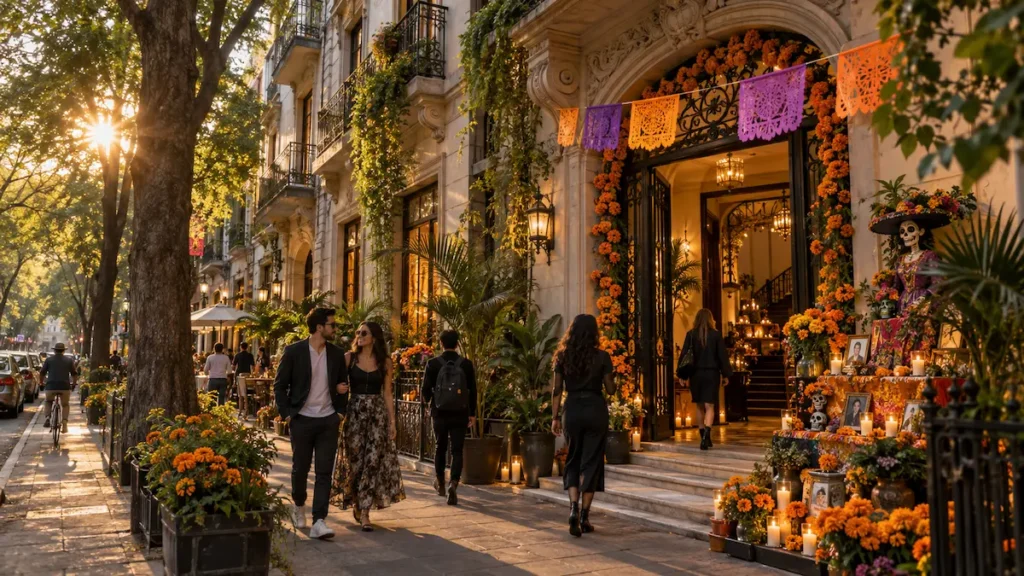
The parade is the spectacle. The observance is the reason to come. On 1 and 2 November the city turns to ofrendas, the altars built for the dead, and the two places most visitors head for are Coyoacán in the south and the Zócalo in the Centro Histórico.
- Coyoacán. The plaza, the market and the streets around it fill with altars and marigolds. The Museo Frida Kahlo is in the same neighbourhood, but book that separately and well ahead. We cover the whole day in our guide to day trips from Mexico City.
- San Ángel. A few streets from Coyoacán, with its own quiet corner for the season: the Museo Casa del Risco, the Museo de El Carmen and the Diego Rivera studio are all a few steps from each other. See the full route in our Coyoacán and San Ángel guide.
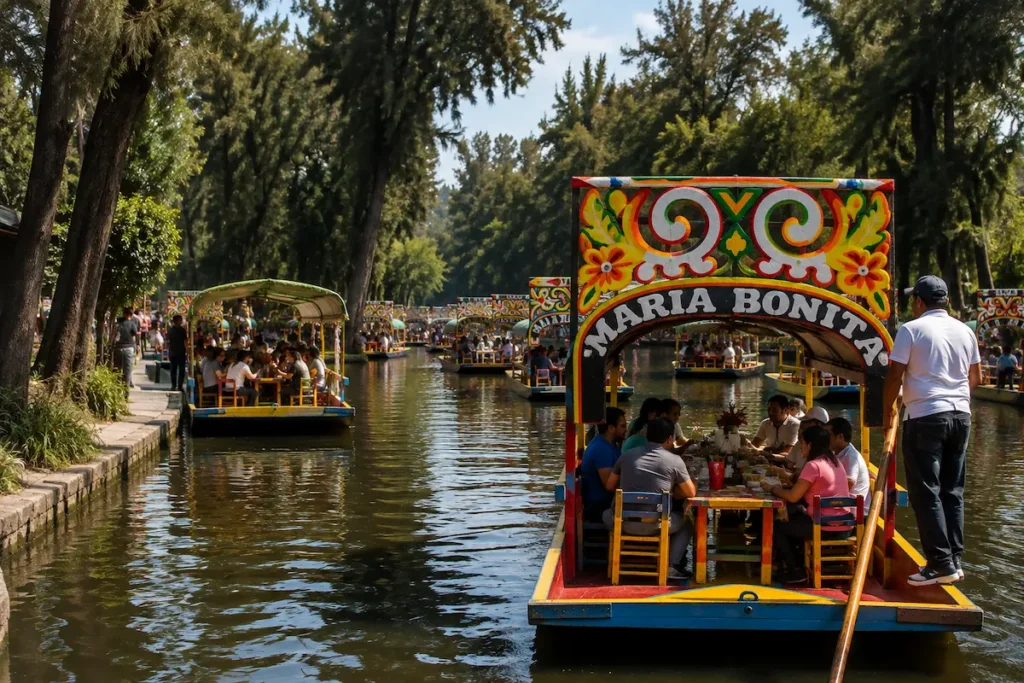
- Museo Dolores Olmedo, Xochimilco. Recently reopened, and known for some of the most traditional, elaborate ofrendas in the city during the season. Worth building into a Xochimilco day if you are down that way.
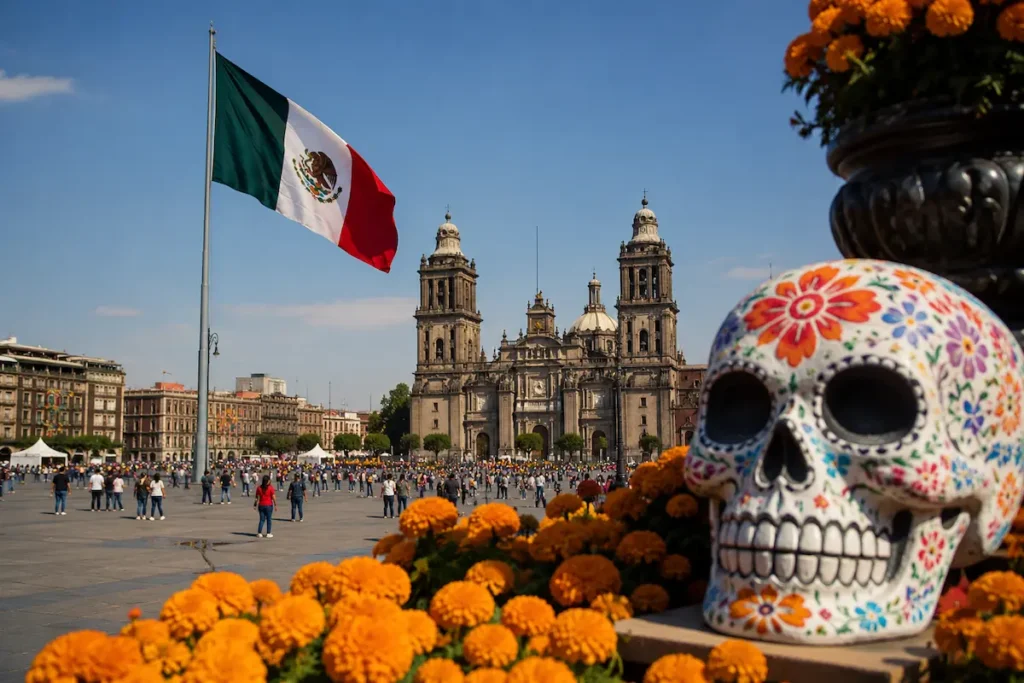
- The Zócalo. The city builds a monumental ofrenda in the main square. Expect crowds all week, not only on the two days.
- San Andrés Mixquic. Far to the southeast, and the most traditional of the accessible options. It is a long round trip, so treat it as a full day.
- Roma Norte itself. Smaller altars appear in restaurants, galleries and shopfronts across the neighbourhood. Our guide to Roma Norte and the architectural walking tour both work well on a quiet morning.
What should you pack, and what is the weather like?
Late October and early November sit at the end of the Mexico City rainy season. Daytime highs average around 23 to 24°C and nights fall to roughly 10 to 12°C. October still gets occasional afternoon showers; by November rainfall is close to nothing. The practical version: light layers, something warm for the evening, and shoes you can stand in for four hours.
One more thing that catches visitors out. Mexico City sits at about 2,240 metres above sea level, and a long day on your feet at that altitude is more tiring than the same day at sea level. We explain what to expect in our guide to the best time to visit Mexico City, and if you are arriving the day before the parade, plan a slow first evening.
Where to eat and drink during Day of the Dead week
Reservations matter more than usual that week, particularly for dinner on the Saturday of the parade. Roma Norte is one of the strongest eating neighbourhoods in the city, which is part of why it works as a base: you can walk to dinner instead of crossing town.
- The best restaurants in Roma Norte, our fullest guide, including which ones need booking weeks ahead.
- Tacos and street food in Roma Norte, for the nights when you get back late.
- Bars and nightlife in Roma Norte.
- Cafés in Roma Norte, for the morning after.
Arriving and getting around
Mexico City International Airport is east of the centre. Traffic during Day of the Dead week is heavier than usual, so allow more time than the map suggests in both directions. Our airport to Roma Norte transport guide sets out the options and what each one costs.
Once you are in the city, the metro is the fastest way south to Coyoacán on 1 and 2 November, and it does not care about street closures. If safety is on your mind, our guide to the safest neighbourhoods in Mexico City for tourists covers which areas are comfortable to walk in and when.
Frequently asked questions
When is the Day of the Dead parade in Mexico City in 2026?
Mexico City’s Desfile de Día de Muertos is confirmed for Saturday 31 October 2026. The planned route runs from the Puerta de los Leones in Bosque de Chapultepec along Paseo de la Reforma to the Zócalo. The start time and the final route are confirmed by the city authorities closer to the date.
Which neighbourhood is best for Day of the Dead in Mexico City?
Roma Norte. It sits directly south of Paseo de la Reforma, so the parade route is walkable on a day when traffic is closed or crawling, and it has metro and Metrobús links south to Coyoacán for the ofrendas on 1 and 2 November.
How far in advance should I book a hotel for Day of the Dead?
Before the end of September, and earlier for small properties. Day of the Dead is one of the busiest weeks of the Mexico City year and independent hotels sell out first. Casa Goliana has eight rooms, so the window is short.
Are Day of the Dead and Halloween the same thing?
No. Día de Muertos is observed on 1 and 2 November, one day for children who have died and one for adults. Halloween on 31 October is a separate, imported celebration. In 2026 they sit next to each other because the parade falls on 31 October.
What is the weather like in Mexico City for Day of the Dead?
Daytime highs average around 23 to 24°C and nights drop to roughly 10 to 12°C. October still gets the odd afternoon shower at the tail of the rainy season; November is close to dry. Bring layers and a jacket for the evening.
Is Day of the Dead a good time to visit Mexico City for the first time?
Yes, with one caveat: the city is full, prices are at their annual peak and the major sights are busy. If it is your first visit and you want the museums and the neighbourhoods at a calmer pace, consider the second half of November instead. Our guide to Mexico City in November covers what the rest of the month looks like.
Written by Jose Gaspard, travel editor at Casa Goliana, an eight-room boutique hotel in a restored early twentieth-century mansion at Guanajuato 199, Colonia Roma Norte, Mexico City. Casa Goliana has been featured in The New York Times, Condé Nast Traveler and Architectural Digest.
Parade date confirmed against Mexico City press reports of August 2026; metro and Metrobús fares are the 2026 published rates. Route and start time are subject to official confirmation by the city authorities.
Related: Day of the Dead parade guide · Complete Day of the Dead guide · Mexico City in November · Our rooms · FAQ