Quick answer: Teotihuacán is about 50 km northeast of Mexico City and opens daily from 8:00am to 5:00pm. Admission in 2026 is 210 pesos for foreign visitors, with a 50% discount for Mexican nationals and foreign residents who can prove residency, and free Sunday entry for those same groups. The cheapest way there is the Autobuses Teotihuacán service from the Central de Autobuses del Norte — 60 pesos each way, departures every 15 minutes, about an hour. And the thing most guides still get wrong: you can no longer climb the Pyramid of the Sun. Ascent has been closed since 2020 with no reopening date.
What’s on this page
- First: the climbing rules have changed
- 2026 prices, hours and gates
- Getting there: bus, car, or tour
- What to see, in the right order
- What Teotihuacán actually was
- Hot air balloons: what you are paying for
- When to go
- What to bring
- A full-day plan
- Frequently asked questions
First: the climbing rules have changed
If you have read an older guide, seen an old photograph, or been told by a friend who visited years ago that the highlight is climbing to the top of the Pyramid of the Sun — that is no longer possible.
- The Pyramid of the Sun has been closed to ascent since 2020. The suspension began as a pandemic measure and has been maintained by INAH, the national institute that administers the site, to limit the erosion caused by constant foot traffic. There is no official reopening date, and federal authorities confirmed it would not reopen for the 2026 World Cup.
- The Pyramid of the Moon is heavily restricted. Where access is permitted at all, it reaches only the lower platform — never the summit.
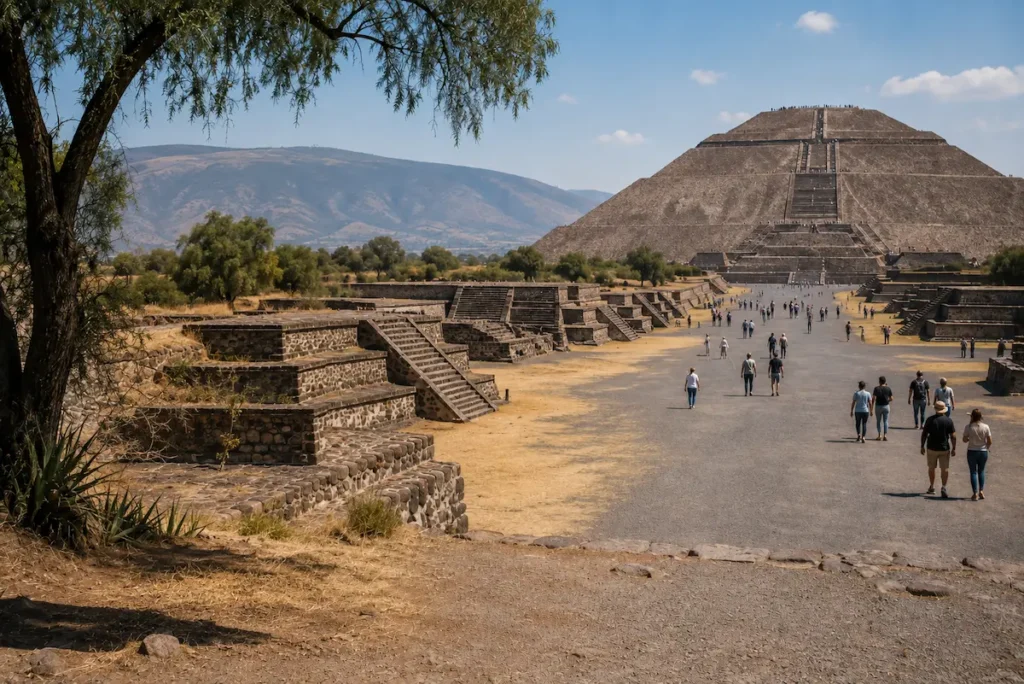
What you can still do, and it is a great deal: walk the entire Calzada de los Muertos, circle both pyramids at ground level, enter La Ciudadela and the Temple of Quetzalcóatl, visit the palace complexes with their surviving murals, and go through the site museum. The scale of the place is the experience, and the scale is best appreciated from the avenue anyway.
Two practical consequences: the visit is less physically demanding than it used to be, which matters at 2,300 metres of altitude; and any tour operator still selling “climb the Pyramid of the Sun” is selling you something they cannot deliver.
2026 prices, hours and gates
| Item | 2026 detail |
| Admission — foreign visitors | 210 pesos |
| Admission — Mexican nationals and foreign residents | 50% discount, with proof of nationality or residency |
| Free entry | Sundays for Mexican nationals and foreign residents; and for over-60s, under-13s, pensioners, visitors with disabilities, and teachers and students with valid credentials |
| Opening hours | Daily, 8:00am–5:00pm (last admission earlier — arrive well before closing) |
| Gates | Five numbered entrances around the perimeter. Buses from Mexico City arrive at Gate 2 |
| Site museum | Included in admission |
A note on free Sundays: as at INAH museums, the Sunday exemption applies to Mexican nationals and foreign residents with valid immigration documents, not to visitors on a tourist permit. Sunday is also by some distance the busiest day at the site. Tuesday to Thursday is the better trade for everyone.
Getting there: bus, car, or tour
By bus — the cheapest and genuinely easy option
The Autobuses Teotihuacán service runs from the Central de Autobuses del Norte, reachable on Metro Line 5 at the Autobuses del Norte station.
- Fare: 60 pesos one way.
- Frequency: every 15 minutes.
- Service hours: daily, roughly 6:00am to 9:00pm.
- Journey time: about an hour, traffic depending, with a single stop in the town of San Juan Teotihuacán.
- Drop-off: Gate 2 of the archaeological zone.
Buy at the counter inside the terminal — ask for Pirámides, not Teotihuacán, which is also the name of the town. Keep your return ticket plans loose; buses back run frequently until evening.
By car or ride-hail
Around an hour each way outside peak times via the Mexico–Pachuca highway. Parking is available at the gates for a small fee. A ride-hailing car out is straightforward; getting one back from the site is less reliable, so agree a return with your driver or plan on the bus.
By organised tour
Tours typically bundle round-trip transport, a guide, and often a stop at the Basilica of Guadalupe and a tequila or obsidian workshop. The trade: convenience and interpretation, in exchange for a fixed schedule and the workshop stops, which are commercial. If you want the archaeology explained properly, a guide is genuinely valuable here — the site is enormous and largely unlabelled. You can also hire an accredited guide at the gate.
By Turibus
Turibus also runs a route out to Teotihuacán, departing from its usual stops around the city centre. It’s a middle option between the public bus and a private tour: more comfortable and structured than the Autobuses Teotihuacán service, without the fixed guide and workshop stops of a typical organised tour. Book directly with Turibus and check the current schedule before you go, since departures are less frequent than the public bus
What to see, in the right order
The site is roughly 4 km end to end along its main axis. Doing it in the wrong order means walking it twice.
- Start at Gate 1 or 2, at La Ciudadela. The vast sunken plaza at the southern end, containing the Temple of Quetzalcóatl — the most sculpturally elaborate structure on the site, with alternating feathered serpent and Tláloc heads projecting from the facade. Arriving here first means walking the avenue northwards, with the Pyramid of the Sun ahead of you.
- Walk the Calzada de los Muertos. The Avenue of the Dead, about 4 km long and 40 metres wide, flanked by platform structures. The Mexica gave it that name centuries after the city was abandoned, believing the platforms were tombs. They were not.
- The Pyramid of the Sun. Roughly 65 metres high — one of the largest pyramids in the world by volume. Circle it; it reads differently from each side.
- The Palace of Quetzalpapálotl and the Jaguar Palace. Beside the Plaza of the Moon: carved pillars, restored roofing and some of the best-preserved murals accessible to visitors.
- The Pyramid of the Moon and its plaza. Smaller than the Sun at around 43 metres, but built on higher ground, so the summits are level. The Plaza of the Moon, looking back down the avenue, is the single best view on the site.
- The site museum. Included, air-conditioned, and it makes sense of everything you have just walked past. Do not skip it because you are tired.
- Tepantitla, if you have energy. A residential compound outside the main circuit with the famous Tlalocan mural — a painted paradise scene that is the most extraordinary surviving artwork at the site.
What Teotihuacán actually was
Teotihuacán was not built by the Aztecs. This is the most common misconception about the site, and correcting it changes how you see it.
The city flourished roughly between the first and sixth centuries CE. At its height it may have held between 100,000 and 200,000 people, which made it one of the largest cities in the world at the time — larger than contemporary Rome’s rivals in the Americas by a wide margin, and laid out on a rigid grid aligned some 15 degrees east of north.
Then it collapsed, for reasons still argued over: internal upheaval, drought, fire, or some combination. By the time the Mexica arrived in the valley, it had been abandoned for seven hundred years. They found the ruins, judged them the work of gods, and gave the site the Nahuatl name we still use — commonly translated as the place where men become gods. The names Pyramid of the Sun, Pyramid of the Moon and Avenue of the Dead are all Mexica interpretations, not Teotihuacano ones. We do not know what the builders called their own city, or what language they spoke.
It was inscribed as a UNESCO World Heritage Site in 1987.
Do this first, if you can: spend a morning in the Teotihuacan hall of the Museo Nacional de Antropología before you visit the site. The murals, the masks and the reconstructions there are the interpretive key. Visiting in that order turns the pyramids from impressive geometry into a readable city.
Hot air balloons: what you are paying for
Balloon flights launch at dawn from fields near the site and are the reason for much of Teotihuacán’s social-media presence. Honest assessment:
- What you get: roughly 40–60 minutes aloft at sunrise, with the pyramids below and the valley beyond. It is genuinely spectacular.
- What it costs you: a very early start — pick-ups from central Mexico City are commonly around 4:30–5:00am — and a significant sum relative to everything else on this page.
- What to check: that the operator is properly certified, that flight duration is specified in writing, and what the cancellation policy is. Flights are weather-dependent and cancellations are routine.
- Timing note: the balloon flight ends before the archaeological zone opens at 8:00am, so the two combine neatly into one long day rather than competing.
When to go
- Day of week: Tuesday to Thursday. Sunday is free for nationals and residents and correspondingly packed; Saturday is busy with tours.
- Time of day: arrive at opening, 8:00am. The site has almost no shade, the light is best early, and the tour coaches arrive from about 10:00am.
- Season: the dry season, November to May, gives you clear skies and no afternoon downpours. See our guides to Mexico City in November and the best time to visit Mexico City.
- Avoid the spring equinox unless the crowd is the point. Tens of thousands of visitors come dressed in white for the March equinox and INAH runs a special operation for it. It is a spectacle, and it is not a good day to see the archaeology.
What to bring
- Sun protection above everything. High-SPF sunscreen, a hat and sunglasses. The site is exposed, treeless and at over 2,300 metres, where UV is punishing even on a cool day. This is the single most common way people ruin the visit.
- Water, more than you think — at least a litre and a half per person.
- Proper shoes. You will walk 6–10 km on uneven volcanic stone.
- Cash for the bus, the gate, guides and the vendors.
- A light layer for the early morning; it is cold at 7:00am and hot by 11:00am.
- Note: tripods, drones and professional equipment require permits from INAH. Phone photography for personal use is fine.
The altitude at the site is slightly higher than in the city, and the walking is longer than most visitors anticipate. If Teotihuacán is early in your trip, read our practical travel tips for first-time visitors first — the section on acclimatising is the difference between a good day here and a headache.
Common misconceptions, cleared up
| What people believe | What is actually true |
| You can climb the Pyramid of the Sun | Closed to ascent since 2020, with no reopening date |
| The Aztecs built it | Abandoned roughly seven centuries before the Mexica arrived in the valley |
| It is a half-day trip | A full day: 3–4 hours on site plus an hour of travel each way |
| Sunday is free for everyone | Free entry applies to Mexican nationals and foreign residents only — and it is the busiest day |
| You can combine it with Xochimilco | They are in opposite directions, roughly 75 km apart. One per day |
| The Avenue of the Dead is a burial site | A Mexica misinterpretation of the platform structures. It is not a necropolis |
What to do with the rest of the day
You will be back in the city by early evening with tired legs and a good appetite. Two things that work well after a Teotihuacán day, both of which require no further walking:
- A long dinner in Roma Norte — see the Roma restaurants guide, or the tacos and street food guide if you want something faster.
- Lucha libre at Arena México, if it is a Tuesday, Friday or Sunday — seated, indoors and fifteen minutes from Roma Norte. See our Arena México guide.
If you are in town for the last weekend of October 2026, note that the site will be busy: our F1 Grand Prix guide explains why that week is unlike any other in the city’s year.
A full-day plan
| Time | What you’re doing |
| 6:45am | Leave Roma Norte. Metro Line 1 to Line 5, or a car to the Central del Norte |
| 7:30am | Bus from the Central de Autobuses del Norte — 60 pesos, every 15 minutes |
| 8:45am | Arrive Gate 2. Buy admission and start at La Ciudadela |
| 9:00am–12:30pm | Avenue of the Dead northwards: Temple of Quetzalcóatl, Pyramid of the Sun, the palaces, Plaza of the Moon |
| 12:30pm | Site museum, then lunch. The restaurants around the perimeter are tourist-priced; the town of San Juan Teotihuacán is better and cheaper |
| 2:30pm | Tepantitla murals if you still have legs, otherwise start back |
| 4:00pm | Bus back to the city |
| 6:00pm | Back in Roma Norte. You have earned dinner — see our Roma restaurants guide |
Teotihuacán and Xochimilco are the two canonical excursions from Mexico City, and they lie in opposite directions — north and far south. Do not attempt both in one day. Our best day trips from Mexico City guide covers the wider set of options, including Puebla, Tepoztlán and Cholula.
Where to stay
Almost everyone visits Teotihuacán as a day trip from the city rather than staying nearby, and that is the right call — the town has little to hold you after dark. What you want is a central base with a clean route to the northern bus terminal and somewhere good to come back to.
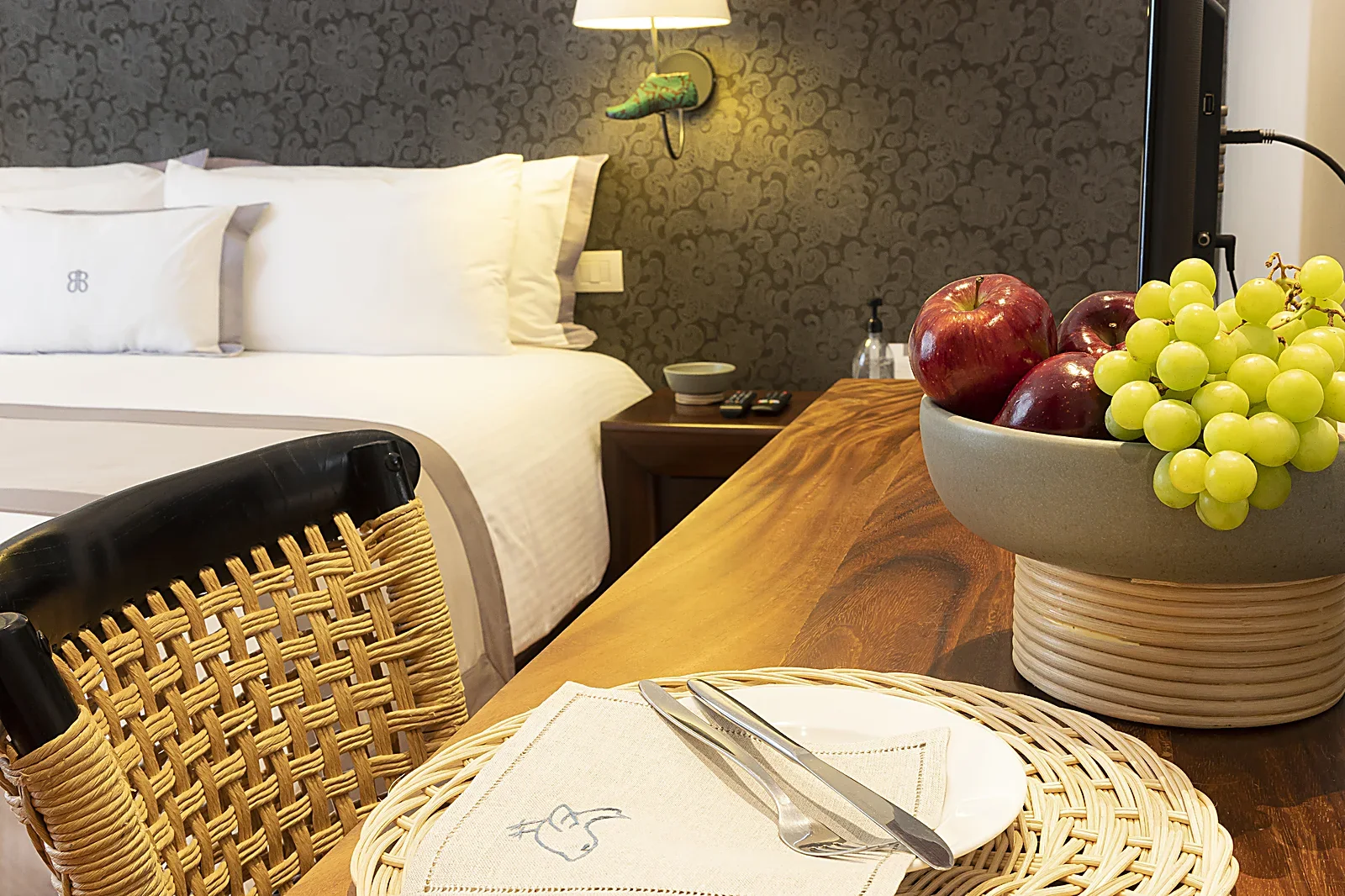
Casa Goliana is an eight-room boutique hotel in a restored early-twentieth-century mansion at Guanajuato 199, Roma Norte, with breakfast included — which on a 6:45am departure is the difference between a good day and a hungry one. See the rooms, the gallery, or check dates on our booking page. Our Roma Norte neighbourhood guide explains why the area works as a base.
Frequently asked questions
Can you climb the Pyramid of the Sun at Teotihuacán in 2026?
No. Ascent of the Pyramid of the Sun has been closed since 2020, initially as a health measure and subsequently maintained by INAH to limit erosion from visitor traffic. There is no official reopening date. Access to the Pyramid of the Moon is also heavily restricted, reaching at most a lower platform rather than the summit. You can still walk the Avenue of the Dead, circle both pyramids, and visit La Ciudadela, the palaces and the site museum.
How much does Teotihuacán cost in 2026?
210 pesos for foreign visitors. Mexican nationals and foreign residents who can prove residency receive a 50% discount, and enter free on Sundays. Over-60s, under-13s, pensioners, visitors with disabilities, and teachers and students with valid credentials are also exempt.
How do I get to Teotihuacán by bus from Mexico City?
Take the Autobuses Teotihuacán service from the Central de Autobuses del Norte, reached via Metro Line 5 at the Autobuses del Norte station. Tickets are 60 pesos one way, buses leave every 15 minutes between roughly 6:00am and 9:00pm, and the journey takes about an hour, arriving at Gate 2 of the archaeological zone. Ask for Pirámides at the counter.
What are Teotihuacán’s opening hours?
Daily from 8:00am to 5:00pm, with last admission earlier than closing. Arriving at opening is strongly recommended: the site has almost no shade and tour coaches begin arriving around 10:00am.
Was Teotihuacán built by the Aztecs?
No. The city flourished between roughly the first and sixth centuries CE and had been abandoned for around seven hundred years by the time the Mexica arrived in the valley. The Mexica named the site and its monuments; we do not know what the original builders called their own city or what language they spoke.
How long do you need at Teotihuacán?
Three to four hours on site for a proper visit, plus roughly an hour of travel in each direction — so a full day door to door. You will walk between six and ten kilometres on uneven stone at over 2,300 metres of altitude.