Quick answer: Mexico City has one of the highest concentrations of museums of
any city in the world. If you only visit three, make them the Museo Nacional de Antropología (210 pesos for foreign visitors, 105 for Mexican nationals and residents, closed Mondays), the Museo Frida Kahlo / Casa Azul in Coyoacán (320 pesos general admission, online tickets only, sells out days or weeks ahead) and the Palacio de Bellas Artes for the Rivera, Orozco and Siqueiros murals. Sunday entry is free at INAH museums — but only for Mexican nationals and foreign residents, not for tourists.
What’s on this page
- Six rules that make museum days work here
- The big three: start here
- Chapultepec: four museums in one park
- Centro Histórico: murals and Mexica history
- Contemporary art: Soumaya, Jumex, MUAC
- Small museums worth the detour
- 2026 prices and hours at a glance
- Three museum itineraries
- Frequently asked questions
Six rules that make museum days work here
- Almost everything closes on Monday. This is the single most common mistake visitors make. Plan Mondays around parks, markets and neighbourhoods instead — our markets guide is a good Monday.
- Free Sunday is not for tourists. INAH museums and archaeological sites admit visitors free on Sundays, but the benefit applies to Mexican nationals and foreign residents with valid immigration documents. If you are visiting on a tourist permit you pay the standard rate — and Sunday is the most crowded day of the week. Go on a Tuesday or Wednesday instead.
- Book Frida Kahlo before you book anything else. The Casa Azul sells tickets online only, with no in-person sales at all, and slots regularly sell out days or weeks in advance, especially at weekends and around holidays.
Foreign-issued credit cards aren’t accepted on the ticketing site — Casa Goliana can buy them on your behalf, charged to your room and subject to availability, as long as it’s arranged before you arrive.
- Two museums a day is the ceiling. At 2,240 metres, with the walking involved, three is ambitious and four is a bad afternoon. Our practical travel tips cover altitude pacing.
- Bring ID if you qualify for a discount. Student, teacher and senior rates are real and substantial, but they require valid identification, and Mexican-national rates require proof of nationality or residency.
- Cash is still useful. Card acceptance is standard at the major institutions, but smaller museums, lockers and cafés often prefer cash.
The big three: start here
1. Museo Nacional de Antropología
The single most important museum in Mexico and, by a wide margin, the one to see if you see only one. Twenty-three exhibition halls arranged around a central courtyard beneath an enormous cantilevered concrete umbrella — an architectural landmark in its own right — covering the pre-Hispanic civilisations of Mexico from the Olmec through the Maya, Teotihuacan, Toltec and Mexica.
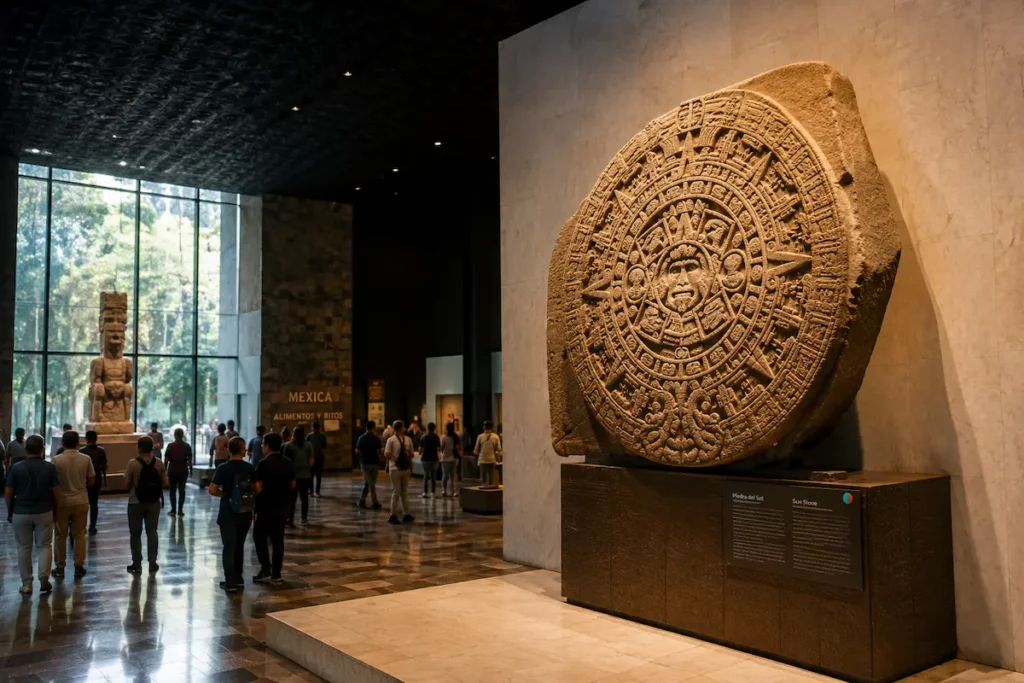
What you are there for: the Piedra del Sol (widely known as the Aztec calendar stone), the colossal Olmec heads, the reconstructed tomb of Pakal from Palenque, the Teotihuacan hall, and the Maya rooms. Give it three hours minimum; a full day is not excessive.
- 2026 admission: 210 pesos for foreign visitors; 105 pesos for Mexican nationals and foreign residents who can prove nationality or residency.
- Hours: Tuesday to Sunday, 9:00–18:00. Closed Mondays.
- Where: Bosque de Chapultepec, on Paseo de la Reforma.
- From Roma Norte: Metro Line 1 from Insurgentes to Chapultepec, then a walk through the park; or 15 minutes by car.
Tip: if you are also planning a day trip to Teotihuacán, do the museum first. The Teotihuacan hall is the interpretive key that turns the pyramids from impressive rubble into a legible city.
2. Museo Frida Kahlo — La Casa Azul
The cobalt-blue house at Londres 247 in Coyoacán where Frida Kahlo was born, lived with Diego Rivera and died. It is not a large museum, and that is precisely the point: her studio, her wheelchair at the easel, her bed with the mirror above it, her corsets, her clothing, and a garden that has been left largely as she kept it.
It is the most-demanded museum ticket in Mexico. Manage that accordingly.
- 2026 admission: 320 pesos general; 160 pesos for Mexican nationals with ID; 60 pesos for students and teachers with ID; 30 pesos for seniors and children aged 6–12; free for children under 6 and for visitors with disabilities.
- Hours: Closed Mondays. Tuesday 10:00–18:00; Wednesday 11:00–18:00; Thursday to Sunday 10:00–18:00. Reduced hours (10:00–14:00) on 15 September, 24 December and 31 December.
- Tickets: Online only — there are no in-person sales. Buy through the museum’s official ticketing site well ahead.
- Included: admission also gives you courtesy entry to the Museo Diego Rivera-Anahuacalli, Rivera’s volcanic-stone temple-museum, also in Coyoacán. Most visitors never realise this and skip it.
- Where: Londres 247, Col. Del Carmen, Coyoacán 04100.
- From Roma Norte: roughly 25–35 minutes by car depending on traffic, or Metro Line 3 south to Coyoacán or Viveros followed by a walk.
Honest expectation-setting: the Casa Azul is small and busy, and your visit is a timed slot. Give the rest of Coyoacán the afternoon — the plaza, the market, the Anahuacalli — and the trip becomes worth the journey rather than a twenty-minute queue for a house.
3. Museo del Palacio de Bellas Artes
The white marble palace at the edge of the Alameda Central is the city’s most photographed building, and most visitors photograph it and leave. Go inside. The upper floors hold the great mural cycle of Mexican modernism: Diego Rivera’s Man, Controller of the Universe — his recreation of the Rockefeller Center mural that was destroyed in New York — alongside major works by José Clemente Orozco, David Alfaro Siqueiros, Rufino Tamayo and Jorge González Camarena.
The building itself is a collision of Art Nouveau exterior and Art Deco interior, with a Tiffany glass stage curtain depicting the valley of Mexico. The Ballet Folklórico de México performs here regularly, and it is worth checking the programme.
- Hours: Tuesday to Sunday. Closed Mondays.
- Note: museum admission and performance tickets are separate. Check the current programme and rates on the official site before you go.
- From Roma Norte: Metro Line 1 from Insurgentes towards the centre; around 20 minutes by car outside rush hour.
Chapultepec: four museums in one park
Bosque de Chapultepec is one of the largest urban parks in the Western Hemisphere and holds four significant museums within walking distance of each other. It is the most efficient museum geography in the city, and it is a straight two stops on Metro Line 1 from Roma Norte.
Museo de Arte Moderno (MAM)
The permanent collection of twentieth-century Mexican art, and the home of Frida Kahlo’s Las Dos Fridas — her largest painting and, for many visitors, a more moving encounter than anything at the Casa Azul. Also Remedios Varo, Leonora Carrington, Rivera, Siqueiros and Tamayo. Closed Mondays.
Museo Tamayo Arte Contemporáneo
Rufino Tamayo’s donation of his international contemporary collection, in a striking brutalist building set into the park. Strong temporary exhibitions; a good counterweight if the Mexican modernists are starting to blur. Closed Mondays.
Castillo de Chapultepec — Museo Nacional de Historia
The only true castle in North America to have housed sovereigns: Emperor Maximilian and Empress Carlota lived here in the 1860s. It holds the national history collection, the murals of Siqueiros and O’Gorman, and the best panoramic view of Paseo de la Reforma. It sits on a hill and the walk up is the altitude test of your trip. Closed Mondays; INAH rates apply.
Museo Nacional de Antropología
Covered above — and it is in the same park, which is why a Chapultepec day works so well.
Centro Histórico: murals and Mexica history
Templo Mayor
The excavated main temple of Tenochtitlan, discovered by accident in 1978 by electricity workers laying cable beside the cathedral. You walk above the layered platforms of the Mexica ceremonial centre, then enter a museum built around the eight-tonne Coyolxauhqui monolith. Nothing else in the city collapses five centuries into a single site so bluntly. Closed Mondays; INAH rates.
Museo Nacional de Arte (MUNAL)
Mexican art from the viceregal period to the mid-twentieth century, in a palatial 1900s building on a quiet plaza. Reliably uncrowded compared with everything else on this list. Closed Mondays.
Palacio Nacional
Rivera’s monumental staircase murals narrating Mexican history from the pre-Hispanic world to the twentieth century. Access is controlled and schedules change; check current visiting arrangements before making the trip.
A Centro day pairs well with the food. See our guide to the best markets in Mexico City for where to eat between stops.
Contemporary art: Soumaya, Jumex, MUAC
Museo Soumaya
The mirrored, hourglass-shaped tower in Plaza Carso, Polanco — Carlos Slim’s foundation collection, and one of the most photographed buildings in the city. Inside: Rodin (one of the largest collections outside France), Dalí, European old masters and Mexican art across six spiralling floors. Admission is free, every day.
Museo Jumex
Directly across the plaza from the Soumaya, and its opposite in every way: a restrained sawtooth-roofed building by David Chipperfield holding one of Latin America’s most important contemporary art collections. The two together make a single, easy afternoon.
MUAC — Museo Universitario Arte Contemporáneo
On the UNAM campus in the south of the city, inside the UNESCO-listed Ciudad Universitaria. Serious contemporary programming, and the campus itself — with Juan O’Gorman’s mosaic-covered Central Library — is worth the trip. It is far; give it a half-day.
If contemporary art is the reason you came, Roma Norte itself is a gallery district. Our self-guided gallery tour of Roma Norte maps the walkable version, and the Art Week and Zona Maco guide covers February’s fair season.
Small museums worth the detour
- Museo Diego Rivera-Anahuacalli — Rivera’s black volcanic-stone pyramid-museum in Coyoacán, built to house his pre-Hispanic collection. Included with your Frida Kahlo ticket.
- Museo Casa Estudio Diego Rivera y Frida Kahlo — the Juan O’Gorman-designed functionalist twin houses in San Ángel, joined by a rooftop bridge. Architecturally the most interesting building either of them lived in.
- Museo de Arte Popular (MAP) — Mexican folk art and craft across the country’s regions, in a striking Art Deco former fire station near the Alameda.
- Museo de Arte Textil de los Pueblos Indígenas y Afromexicanos — a newer museum dedicated to indigenous and Afro-Mexican textile traditions, a living-heritage counterpart to the folk-art collections nearby.
- Museo Nacional de Antropología’s neighbour, Museo Rufino Tamayo — see above; the two are five minutes apart.
- Museo del Objeto del Objeto (MODO) — a design and everyday-object museum in an Art Nouveau house in Roma Norte, a ten-minute walk from Casa Goliana. Small, idiosyncratic and almost never crowded.
- Museo Casa Luis Barragán — the Pritzker-winning architect’s own house, a UNESCO World Heritage Site. Visits are by guided tour and by advance reservation only; numbers are strictly limited.
2026 prices and hours at a glance
| Museum | 2026 admission | Hours | Area |
| Museo Nacional de Antropología | 210 MXN foreign visitors / 105 MXN nationals and residents | Tue–Sun 9:00–18:00 | Chapultepec |
| Museo Frida Kahlo (Casa Azul) | 320 MXN general / 160 nationals / 60 students & teachers / 30 seniors & children 6–12 | Tue 10–18, Wed 11–18, Thu–Sun 10–18 | Coyoacán |
| Museo Soumaya | Free | Daily (check current hours) | Polanco |
| Museo del Palacio de Bellas Artes | Check official rates | Tue–Sun | Centro |
| Templo Mayor | INAH standard rate | Tue–Sun | Centro |
| Castillo de Chapultepec | INAH standard rate | Tue–Sun | Chapultepec |
| Museo de Arte Moderno | Check official rates | Tue–Sun | Chapultepec |
| Museo Jumex / MUAC / Tamayo | Modest, varies by exhibition | Tue–Sun | Polanco / South / Chapultepec |
Prices and hours change. The figures for Antropología and the Casa Azul are the published 2026 rates; verify the others on each museum’s official site before you travel, particularly around public holidays.
Three museum itineraries
One free day: the Chapultepec day
Antropología at opening (9:00, before the coach parties), three hours inside, lunch in the park, then either the Museo de Arte Moderno or the Castillo depending on how your legs feel. Two stops on Metro Line 1 from Roma Norte, home by 6pm.
Two free days: add Coyoacán
Day two: pre-booked Casa Azul slot in the morning, Coyoacán plaza and market for lunch, then cross into San Ángel for the Museo Casa Estudio Diego Rivera y Frida Kahlo and the Museo Casa del Risco on Plaza San Jacinto. It is a complete day and a genuinely different side of the city
Three free days: add the Centro
Day three: Templo Mayor, then the Bellas Artes murals, then MUNAL if you still have appetite. Finish with a drink back in Roma Norte — see the Roma Norte bars guide.
For a broader three-day plan that mixes museums with food and neighbourhoods, see our three-day Mexico City itinerary. Travelling with older kids? The family travel guide for teenagers flags which of these actually hold their attention.
When to plan your museum days
Museums are the correct answer to the two situations that wreck otherwise good itineraries here: the rainy afternoon, and the day the city is too busy to move through.
- Tuesday to Thursday is the sweet spot. Monday is closed, Friday is busy, and the weekend — especially Sunday, when nationals and residents enter INAH sites free — is the most crowded stretch of the week.
- The dry season, November to May, is peak visitor season and the queues reflect it. Our guide to Mexico City in November maps which weeks are worst, and the best time to visit Mexico City covers the year.
- Around big events, invert the logic. During the F1 Grand Prix weekend from 30 October to 1 November 2026, the crowd is at the Autódromo and downtown for the Day of the Dead parade — which makes it, counterintuitively, an excellent time to have Chapultepec largely to yourself on the Friday morning.
- Check for closures around public holidays. Schedules shift on 15–16 September, 1–2 November, 16 November and over Christmas, and several museums run reduced hours on 24 and 31 December.
Beyond the museums
Mexico City’s cultural life is not confined to buildings with ticket desks. Three things worth putting alongside a museum day:
- Xochimilco. The canals are a UNESCO World Heritage Site and a living pre-Hispanic agricultural landscape, not an exhibit — see our Xochimilco and trajineras guide.
- Lucha libre. A hundred-year-old performance tradition with its own iconography, staged three nights a week at Arena México — arguably the most alive piece of Mexican popular culture you can buy a ticket to. See our Arena México guide.
- The markets. Craft, food and flowers, and the place where the objects in the museum vitrines are still being made — our markets guide has the map.
Where to stay for a museum trip
Museum days are transport days, and the two things that matter are being on Metro Line 1 (which runs to both Chapultepec and the Centro) and having somewhere pleasant to collapse afterwards. Roma Norte does both, and it is a museum district in miniature besides — MODO, the Roma galleries, the Museo Casa Guillermo Tovar y de Teresa and the Art Deco architecture are all on the doorstep.
Casa Goliana is an eight-room boutique hotel in a restored early-twentieth-century mansion at Guanajuato 199, a short walk from Insurgentes station and from the Roma galleries. Breakfast is included, which matters on days you want to be at Antropología for opening. See the rooms, the gallery, or check dates on our booking page. Our Roma Norte neighbourhood guide explains the area in full.
Frequently asked questions
How much does the Museo Nacional de Antropología cost in 2026?
210 pesos for foreign visitors, and 105 pesos for Mexican nationals and foreign residents who can prove nationality or residency. It opens Tuesday to Sunday, 9:00 to 18:00, and closes on Mondays.
How do I buy Frida Kahlo Museum tickets?
Online only, through the museum’s official ticketing site. There are no in-person ticket sales at the Casa Azul at all. Slots sell out days or even weeks ahead, particularly at weekends and around holidays, so book before you arrive in Mexico. General admission is 320 pesos in 2026 and includes courtesy entry to the Museo Diego Rivera-Anahuacalli.
Are Mexico City museums free on Sundays?
INAH museums and archaeological sites admit visitors free on Sundays, but the benefit applies only to Mexican nationals and foreign residents with valid immigration documents. Tourists pay the standard rate. Sunday is also the busiest day of the week, so a weekday visit is usually the better trade.
Which day are Mexico City museums closed?
Monday, almost universally. The Museo Nacional de Antropología, the Casa Azul, Bellas Artes, Templo Mayor, the Museo de Arte Moderno and most others all close on Mondays. Plan Mondays around markets, parks and neighbourhood walking instead.
Is the Museo Soumaya free?
Yes. Admission to the Museo Soumaya in Plaza Carso is free every day. It is directly across the plaza from the Museo Jumex, so the two make an easy combined visit.
How many museums can I realistically see in a day in Mexico City?
Two. The city sits at roughly 2,240 metres, the major museums are large, and the distances between districts are significant. Three is possible if two of them are small and in the same area; four turns a good day into an endurance exercise.