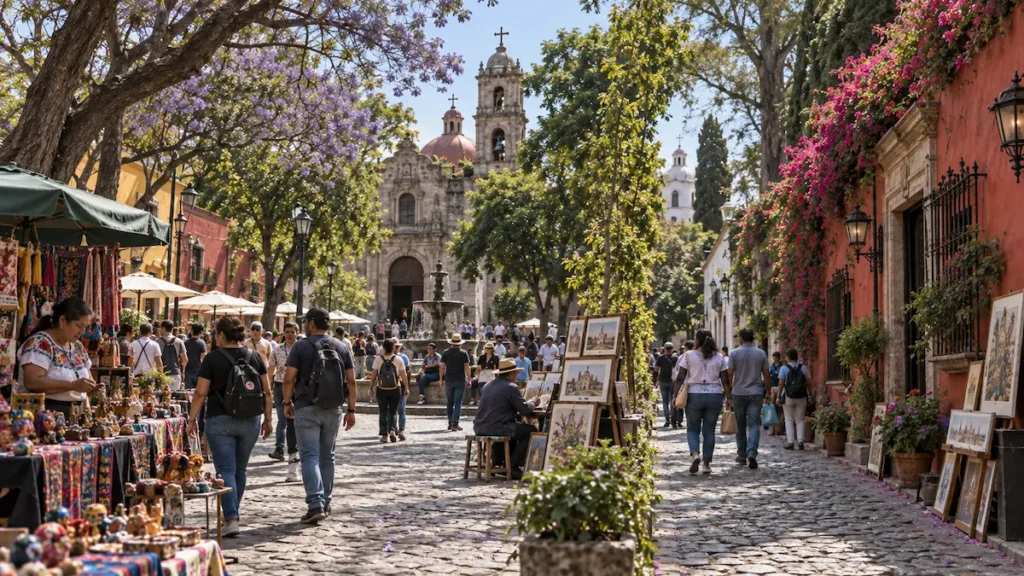
Coyoacán and San Ángel are the two colonial villages the city grew around and never quite swallowed. They sit about four kilometres apart in the south of Mexico City, and almost everyone pairs them. This is how to do both in one day from Roma Norte without spending half of it in a car, and what you have to book before you leave the house.
What you have to book before you go
One thing on this day cannot be improvised: the Museo Frida Kahlo. Tickets for the Casa Azul are sold online only, at boletos.museofridakahlo.org.mx, and they routinely sell out weeks ahead. In high season it can be a month. Entry is by timed slot with a fifteen-minute tolerance; arrive later than that and the ticket is void with no refund.
| What | Booking | Price (2026) | Hours |
| Museo Frida Kahlo, Casa Azul | Online only, weeks ahead, timed slot | 320 MXN general · 30 MXN over-60s and children 6–12 · ticket also covers Museo Diego Rivera Anahuacalli | Tue, Thu–Sun 10:00–18:00 · Wed 11:00–18:00 · closed Monday |
| Museo Casa del Risco, Plaza San Jacinto 5, San Ángel | Walk in | Free entry | Tue–Sun 10:00–17:00 · closed Monday |
| Museo de El Carmen, San Ángel | Walk in | 155 MXN general · 85 MXN nationals and residents · free on Sundays | Wed–Fri 11:00–15:00 · Sat–Sun 10:00–15:00 · closed Mon & Tue |
| Museo Casa Estudio Diego Rivera y Frida Kahlo, San Ángel | Walk in | 45 MXN · free on Sundays · free for students, teachers and INAPAM | Tue–Sun 10:00–17:30 · closed Monday |
| Bazar Sábado, Plaza San Jacinto 11, San Ángel | Walk in | Free entry | Saturdays 10:00–19:00 |
The pattern in that table decides your day. Do not go on a Monday, when both museums are shut. And if you want the Bazar Sábado, it has to be a Saturday.
How do you get from Roma Norte to Coyoacán?
Metro Line 3 runs south from the edge of Roma Norte and is the fastest way down. Get off at Viveros / Derechos Humanos, which is the closest station to the historic centre. The station actually called Coyoacán is further from the plazas than its name suggests, and the walk from it is longer and duller. A metro ride costs 5 pesos in 2026, paid with the rechargeable card.
A taxi or ride-hail from Casa Goliana on Guanajuato 199 takes roughly half an hour outside rush hour and considerably more inside it. On a weekday morning the metro usually wins. If you are staying in Roma Norte and want the full picture on moving around the city, our Mexico City travel tips and the airport transport guide both cover fares and cards.
Coyoacán in the morning
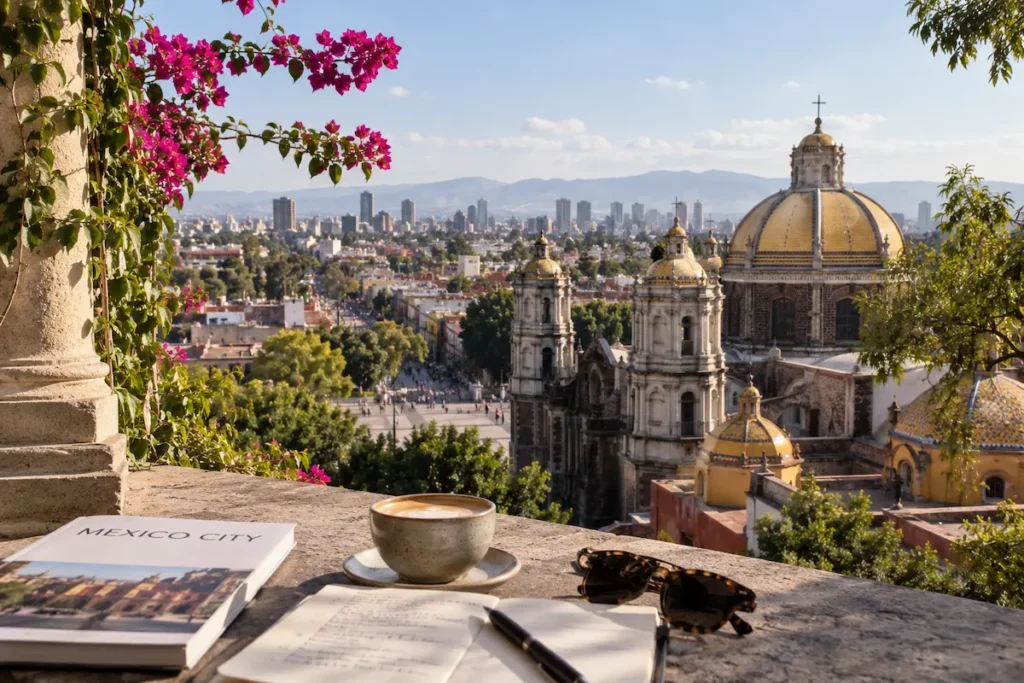
Coyoacán is built around two adjoining plazas, the Jardín Centenario and the Jardín Hidalgo, with the parish church between them and cobbled streets running off in every direction. It is the part of Mexico City that most resembles a small colonial town, which is exactly why it fills up after midday. Arriving before eleven changes the experience.
A working order for the morning:
- The plazas first. Coffee on the Jardín Centenario, then the church and the streets to the east of it before the crowds arrive.
- Mercado de Coyoacán. A covered market a couple of blocks north of the plazas, good for tostadas and for craft stalls. If markets are your thing, we go deeper in our guide to the best markets in Mexico City and in artisan shopping in Mexico City.
- Museo Frida Kahlo. Whatever time slot you managed to book. The house is small and the route through it is one-way, so an hour and a quarter is usually enough.
- Lunch near the plazas, Los Danzantes, right on the Jardín Centenario, is a good sit-down option for author-driven Oaxacan cooking. Then move on.
If your slot at the Casa Azul is in the afternoon, flip the day: San Ángel in the morning, Coyoacán after lunch. The two neighbourhoods work in either order.
San Ángel in the afternoon
San Ángel is quieter, steeper and more residential than Coyoacán, with cobbled streets, high walls and a plaza, Plaza San Jacinto, that turns into an open-air art market at weekends. It sits at roughly the same altitude as the rest of the city, around 2,240 metres, and the streets are genuinely hilly, which is worth knowing before you arrive in the wrong shoes.
Three things anchor the afternoon, all within a short walk of each other around Plaza San Jacinto.
The Museo Casa Estudio Diego Rivera y Frida Kahlo, at the corner of Altavista and Diego Rivera, is the pair of linked modernist houses Juan O’Gorman built for them in the early 1930s: one for him, one for her, joined by a bridge. It is open Tuesday to Sunday, 10:00 to 17:30, admission 45 pesos, free on Sundays. For a building of that importance it is startlingly cheap and rarely crowded.
The Museo Casa del Risco, on Plaza San Jacinto itself, is a former colonial mansion built around a striking fountain of tile and porcelain, with a small collection of viceregal and European painting inside. It’s free entry, Tuesday to Sunday. The Museo de El Carmen, a former Carmelite monastery a few streets away, adds mummified remains in its crypt to a collection of colonial religious art. Both are a few minutes’ walk from the Diego Rivera studio and from each other, so they slot easily into the same afternoon.
The Bazar Sábado, at Plaza San Jacinto 11, runs Saturdays from 10:00 to 19:00. It has been going since 1960 and moved to its current building in 1965. Inside it is jewellery, ceramics, textiles and glass from established makers; outside on the plaza, painters sell canvases straight off the railings. It is the single best reason to make this a Saturday rather than any other day.
Coyoacán or San Ángel: which one if you only have half a day?
Coyoacán, if you want Frida Kahlo and life on a plaza. San Ángel, if you want architecture, craft and quiet. Coyoacán is the busier and more famous of the two, and if you have booked the Casa Azul the choice is already made. San Ángel rewards a slower visit and is the better half for anyone who has been to Mexico City before. Stay long enough for lunch at Tetetlán, which pairs naturally with a visit to Casa Pedregal nearby..
People often frame this as a question about where to live rather than where to spend an afternoon. If that is what you are actually asking, our guides to expat neighbourhoods in Mexico City and the best cities for expats in Mexico deal with it properly.
Where to eat on the way round
Both neighbourhoods have good food and neither is a food destination on the level of Roma Norte. The honest advice: eat something quick and regional while you are down there, and save dinner for when you are back.
- In Coyoacán, the market for tostadas at lunchtime, and any of the cafés on the Jardín Centenario for a break between the plazas and the museum.
- In San Ángel, El Cardenal is a local favourite for classic Mexican cooking, and the San Ángel Inn is the neighbourhood’s old-guard choice for a margarita or a sit-down meal. The restaurants around Plaza San Jacinto fill on Saturdays; go early or accept a wait.
- Back in Roma Norte, our guides to tacos and street food, cafés and bars and nightlife cover the evening.
How this day fits into a longer trip
Coyoacán and San Ángel are a city day, not a day trip. They are inside Mexico City and reachable by metro, which puts them in a different category from Teotihuacán or Puebla. If you are building a longer itinerary, keep them separate in your planning from the genuine excursions covered in day trips from Mexico City and in our Teotihuacán guide.
A sensible shape for a first visit: the historic centre and the major museums on one day, Roma Norte and Condesa on another, Coyoacán and San Ángel on a third, and Xochimilco or Teotihuacán on a fourth. Our three-day itinerary sets out the compressed version.
Frequently asked questions
Do you need to book Casa Azul tickets in advance?
Yes. Museo Frida Kahlo tickets are sold online only, at boletos.museofridakahlo.org.mx, and often sell out weeks ahead. Entry is by timed slot with a fifteen-minute tolerance. Arrive later than that and the ticket is lost, with no refund.
How much does the Frida Kahlo Museum cost?
General adult admission is 320 Mexican pesos as of 2026, and that ticket also covers the Museo Diego Rivera Anahuacalli nearby. Over-60s and children aged 6 to 12 pay 30 pesos.
Can you visit Coyoacán and San Ángel on the same day?
Yes, and most people do. They sit about four kilometres apart in the south of the city. Coyoacán in the morning and San Ángel in the afternoon is the usual order, especially on a Saturday when the Bazar Sábado is open until 19:00.
Which day is best for Coyoacán and San Ángel?
Saturday, for the Bazar Sábado. Avoid Monday: the Museo Frida Kahlo and the Museo Casa Estudio Diego Rivera y Frida Kahlo are both closed, which removes the two main reasons to go.
How do you get from Roma Norte to Coyoacán?
Metro Line 3 south, getting off at Viveros / Derechos Humanos, the closest station to the historic centre. The station named Coyoacán is further from the plazas than the name implies. A ride costs 5 pesos in 2026.
Is Coyoacán safe to walk around?
The historic centre of Coyoacán and the streets around Plaza San Jacinto in San Ángel are among the more comfortable parts of the city to walk in daylight, and both are busy with families at weekends. Our guide to the safest neighbourhoods in Mexico City for tourists covers the wider picture and what changes after dark.
Written by Jose Gaspard, travel editor at Casa Goliana, an eight-room boutique hotel in a restored early twentieth-century mansion at Guanajuato 199, Colonia Roma Norte, Mexico City. See our rooms or the gallery.
Prices and hours checked: 1 September 2026, against the museums’ own published information. Museum hours change seasonally; confirm before you travel.
Related: Day trips from Mexico City · Best museums in Mexico City · Artisan shopping · Things to do in Roma Norte