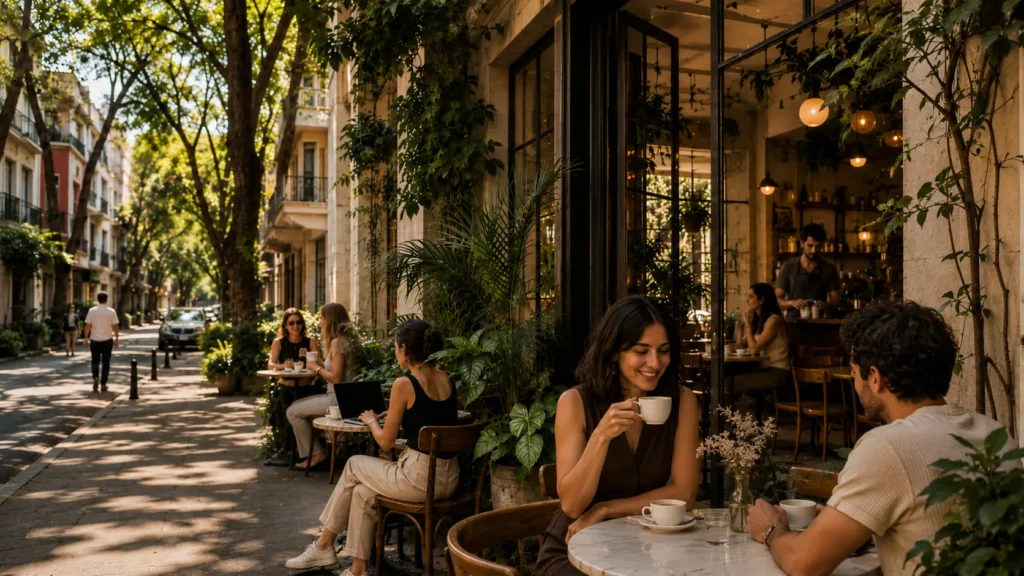
Written by the Casa Goliana team, who grind Mexican coffee for breakfast at Guanajuato 199 every morning. Last updated 11 August 2026.
The short answer
Roma Norte and Condesa have the best and densest specialty coffee in Mexico City, and they are also the two neighbourhoods where working from a café actually works — fast fibre, outlets, long tables. Juárez is a close third. For beans, Café Passmar inside the Mercado Lázaro Cárdenas in Narvarte is the city’s long-standing reference. For tradition rather than espresso, drink café de olla from a clay cup, or stand at the counter of Café El Jarocho in Coyoacán with everybody else.
This is the citywide overview. For the deep dive on our own neighbourhood — which is where most people end up drinking — see the best coffee shops and cafés in Roma Norte.
Mexican coffee: what you are actually drinking
Mexico is a serious coffee country, which surprises visitors who arrive expecting to drink Colombian. The crop grows in the south and along the Gulf — Chiapas, Veracruz, Oaxaca, Puebla and Guerrero — mostly arabica, mostly shade-grown at altitude, mostly by smallholders working plots of a few hectares, and an unusually large proportion of it certified organic.
What that means in the cup: Mexican coffee tends toward chocolate, nut, soft citrus and brown sugar rather than the aggressive fruit of an Ethiopian or the punch of a Sumatran. It is gentle, it takes milk well, and the best Chiapas and Veracruz lots at altitude are genuinely excellent.
The specialty scene in Mexico City matured fast between roughly 2012 and 2020, and it now has its own character: small roasters who buy directly from producer families, menus organised by state and farm, and baristas who will talk you through the whole chain if you ask. Ask which Mexican single origin they are pouring — that question opens more conversations than any other.
Café de olla and the traditional cup
Before espresso arrived, Mexico had — and still has — café de olla: coarsely ground coffee simmered in an earthenware olla with piloncillo, unrefined cane sugar pressed into cones, and a stick of true cinnamon. Some cooks add orange peel, clove or star anise. It is served in a clay cup, which adds its own earthy note, and it is sweet.
Do not think of it as a lesser version of a flat white. It is a different drink with its own logic, it is the thing to order with pan dulce at breakfast or with a slice of cake at four in the afternoon, and it is what a Mexican grandmother makes. Most traditional cafeterías and market comedores serve it, and a growing number of specialty cafés have put a good version back on the menu.
Two others worth trying: café lechero, the Veracruz ritual of a small measure of strong coffee in a glass topped with hot milk poured from height, and champurrado, the thick masa-and-chocolate drink that is not coffee at all but belongs to the same part of the morning.
Roma Norte
The densest specialty coffee in Mexico City sits inside about fifteen walkable blocks. Roma Norte is where roasters open their flagship, where new cafés test their concept, and where you can drink four excellent and completely different cups in an afternoon without taking a car.
Names to look for on the street: Buna, one of the roasters that shaped the city’s scene and still one of the best espressos in it; Almanegra, precise and serious about extraction; Cardinal Casa de Café, a roaster with a following among people who care about origin; Quentin Café on Álvaro Obregón, small and consistently good; Cucurucho and Camino a Comala for a calmer room; and Panadería Rosetta on Colima, which is a bakery first — the guava roll is the point — but pours a very decent coffee alongside the best pan dulce in the neighbourhood. Expect a queue at Rosetta, and expect it to be worth it.
Roma Norte is also the best neighbourhood in the city for working from a café, which is why we keep a dedicated guide: the best cafés in Roma Norte, and for remote workers specifically, the Roma Norte wifi café list. Everything else about the neighbourhood is in the complete Roma Norte guide.
Condesa
Ten minutes’ walk west across Insurgentes and the mood changes: curved streets, jacarandas, terraces, and Parque México as the neighbourhood’s living room. Condesa’s cafés are more about sitting outside for two hours than about chasing a perfect extraction, and that is exactly their appeal.
Blend Station is the archetype — a big room with communal tables, plenty of outlets, and a laptop on nearly every surface; it is the default coworking-café of the neighbourhood. Chiquitito Café is the opposite, tiny and warm, better for a conversation than a spreadsheet. Dosis keeps the specialty end honest. For a slower morning, take a coffee and a bench in Parque México and watch the dogs.
If you are weighing the two neighbourhoods as a base, our head-to-head is here: Roma Norte vs Condesa.
Juárez
Between Reforma and Zona Rosa, Juárez has become the design-led corner of the city’s coffee map. Café Nin on Havre is the standout — a bakery and all-day café from the Rosetta family, superb pastry, and one of the nicest rooms in Mexico City to sit in with a book. Buna keeps a location here too. The neighbourhood is a short taxi or a twenty-minute walk from Roma Norte and pairs naturally with a morning on Reforma.
Centro Histórico
The Centro is not where you come for third-wave espresso; it is where you come for the older tradition. Café El Popular on Madero has been serving café con leche and huevos to everyone from night-shift workers to tourists for decades, and it is open at hours nowhere else is. Cafebrería El Péndulo — a bookshop with a café inside, with branches in Roma and Condesa too — is one of the most pleasant places in the city to spend a rainy afternoon.
Around the Alameda and Madero you will also find hotel terraces with views over the rooftops, which are worth the price of a coffee once. Combine any of this with the markets of the Centro — San Juan, La Ciudadela and La Merced are all within reach.
Coyoacán and the south
Café El Jarocho is an institution and an experience: no seats, a queue out of the door, coffee handed through a window, and half of Coyoacán standing on the pavement drinking it. It costs almost nothing and it is one of the most purely local things you can do in the city.
A few streets away, Café Avellaneda represents the other end — a very small room with very serious coffee and a rotating list of Mexican micro-lots. Between the two you have the whole history of Mexican coffee in about four hundred metres. Add the Mercado de Coyoacán tostada counters and you have a complete morning.
Narvarte, Escandón and beyond
Café Passmar, inside the Mercado Lázaro Cárdenas in Narvarte, is where a lot of the city’s coffee people buy their beans — a market stall that has been roasting and selling Mexican coffee for generations, with a small counter attached. If you want one bag to take home, this is where to buy it.
Escandón and San Miguel Chapultepec are the quiet frontier: cheaper rents have pulled in small roasters and the quality is rising fast, without the queues. Polanco, by contrast, runs to hotel lobbies and international names more than to independent roasters — good coffee, less character.
Working from cafés: the scorecard and the etiquette
Mexico City is one of the world’s great cities to work from, and its cafés carry a large part of that reputation. They also carry a certain amount of resentment, earned by people who buy one americano and hold a table for six hours. Here is how to be on the right side of it.
| Neighbourhood | Laptop-friendly | Best hours | Watch out for |
|---|---|---|---|
| Roma Norte | Very — the widest choice in the city | Before 10 am, after 3 pm | 1–3 pm lunch rush; some cafés restrict laptops at weekends |
| Condesa | Very — built for it | Mornings | Terraces fill by 11 am; outdoor tables often have no outlet |
| Juárez | Moderately | Mid-morning | Smaller rooms; the good ones are bakery-first |
| Escandón / San Miguel Chapultepec | Yes, and quiet | Any | Fewer options if your first choice is full |
| Coyoacán | Not really | — | Small rooms, standing counters, weekend crowds |
| Centro Histórico | Patchy | Early | Older buildings; slower connections |
The rules that keep you welcome:
- Order every ninety minutes or so. The table is rented with each cup, not bought with the first.
- Never take a four-top alone, and give up a big table if a group is waiting.
- Take calls outside. A café is not a phone booth, and Mexican café culture is conversational — a loud video call cuts across the room.
- Avoid 1 to 3 pm. That is comida, the main meal of the Mexican day, and the staff need the tables.
- Read the sign. Some cafés now have laptop-free hours or laptop-free weekends. It is not aimed at you personally, and it is not negotiable.
- Tip. Ten percent, in cash, every time.
- Bring a hotspot. Wifi in the central colonias is good, but if a call matters, do not stake it on a café router.
- Speak some Spanish. Un café con leche, por favor costs nothing and changes the temperature of every interaction.
If you are working here for weeks rather than days, a coworking membership at 2,500–5,500 pesos a month is better value and better for your back. We cover the numbers in the cost of living guide and the wider setup in the digital nomad guide.
Ordering: the vocabulary
| You want | Ask for |
|---|---|
| Espresso | Un espresso — or un cortado for espresso with a splash of milk |
| Flat white / small milk coffee | Un flat white is understood everywhere in specialty cafés |
| Filter coffee | Un café de filtro or un americano |
| Coffee with milk | Un café con leche |
| The traditional spiced coffee | Un café de olla |
| Iced | Frío or con hielo |
| Oat milk | Leche de avena |
| Which Mexican origin? | ¿Qué origen mexicano tienen hoy? |
| To take away | Para llevar |
| The bill | La cuenta, por favor |
A note on prices in 2026: espresso runs roughly 45–70 pesos, a flat white or cappuccino 60–95, and a café de olla at a traditional place 25–45. Specialty cafés take card; market stalls and old cafeterías want cash.
Where to buy beans
- Café Passmar, Mercado Lázaro Cárdenas, Narvarte — the classic, and the best place to be advised by someone who has sold Mexican coffee for decades.
- The roasters themselves — Buna, Almanegra, Cardinal and Quentin all sell their own bags in Roma Norte, usually 250 g, with the state and the producer on the label.
- Mercado de San Juan and Mercado de Medellín for good everyday coffee at market prices, alongside the rest of your shopping. See the markets guide.
Beans travel far better than ground coffee, and whole beans are also easier through customs. Ask for the roast date, not the best-before — anything roasted more than a month ago is not what you came for.
Frequently asked questions
Where is the best coffee in Mexico City?
Roma Norte and Condesa hold the highest concentration of specialty roasters and cafés in the city, with Juárez close behind. For beans rather than a cup, Café Passmar inside the Mercado Lázaro Cárdenas in Narvarte is the long-standing reference. Coyoacán has small serious roasters and Café El Jarocho, the city’s great standing-room institution.
Which cafés in Mexico City are good for working on a laptop?
Roma Norte and Condesa are the two neighbourhoods built for it, with fast fibre, outlets and long communal tables. The reliable pattern is to arrive before 10 am or after 3 pm, avoid the 1 to 3 pm lunch rush, order every ninety minutes or so, and never take a four-person table alone. A growing number of cafés now limit laptops at weekends, so check the sign at the door.
Does Mexico grow its own coffee?
Yes. Mexico is one of the world’s significant arabica producers, with most of the crop grown in Chiapas, Veracruz, Oaxaca, Puebla and Guerrero, much of it shade-grown at altitude by smallholders and a large share certified organic. Almost every specialty café in Mexico City serves at least one Mexican single origin.
What is café de olla?
Café de olla is the traditional Mexican preparation: coarsely ground coffee simmered in an earthenware pot with piloncillo, unrefined cane sugar, and a stick of canela, with some cooks adding orange peel, clove or star anise. It is sweet, spiced and served in a clay cup, and it is a different drink from espresso rather than a lesser one.
How much does coffee cost in Mexico City?
In 2026, an espresso at a specialty café runs roughly 45 to 70 pesos and a flat white or cappuccino 60 to 95 pesos, around three to five US dollars. A café de olla or an americano at a traditional cafetería costs 25 to 45 pesos. Bags of good Mexican single-origin beans are typically 220 to 400 pesos for 250 grams.
Do Mexico City cafés have good wifi?
In the central colonias, yes — fibre is widespread and speeds in Roma Norte, Condesa and Juárez are generally comfortable for video calls. Reliability drops in older buildings and in the Centro Histórico. If your day depends on a call, take it from your hotel or a coworking space rather than a café, and keep a phone hotspot as backup.
What time do cafés open in Mexico City?
Most specialty cafés open between 8 and 9 am on weekdays, a little later at weekends, and close between 7 and 9 pm. Traditional cafeterías in the Centro open earlier. Mexico City is not an early-breakfast city: at 8 am you will often have the room to yourself, which for anyone who wants to work is the best hour of the day.
Is tap water safe for coffee?
Cafés and restaurants use purified water for coffee, ice and juices as standard, so you do not need to think about it when you are out. At home, everyone drinks from a 20-litre garrafón rather than the tap.
Start with the coffee at breakfast
Casa Goliana serves freshly ground Mexican coffee with breakfast every morning at Guanajuato 199, alongside fruit sliced that day, house-made jelly and pastries delivered from one of the neighbourhood’s best bakeries. Eight rooms in a restored early 20th-century mansion, in the middle of the best coffee neighbourhood in the city.
Book direct · See the rooms · Breakfast, check-in and the practical details